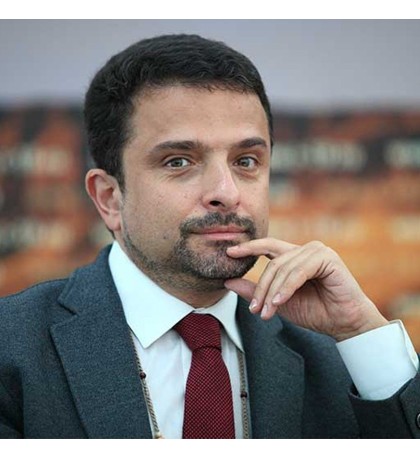
Aleksandr Arkhangelskiy
Included by the Russian Ministry of Justice on 01.11.2024 in the register of mass media outlets and individuals performing the functions of a foreign agent.
Alexander Nikolayevich Arkhangelsky is a Russian writer, literary scholar, and critic, and a researcher of the biography of Emperor Alexander I. He is a journalist, columnist, publicist, editor, and a popular television host. He is a member of the Union of Russian Writers, founder and president of the Academy of Russian Contemporary Literature (ARSS), and of the Russian Television Academy. He is the author of books, including children’s books, literature textbooks, and numerous articles.
Alexander grew up without a father, on the outskirts of Moscow. His mother, Lyudmila Tikhonovna Arkhangelskaya, worked as a typist in the children’s editorial department of Radio. Her parents, who had Greek roots, died early, but his great-grandmother, an elementary school teacher, lived in the family for a long time. As a boy, he attended a literary club at the Palace of Pioneers. After entering the Faculty of Russian Language and Literature at the Moscow State Pedagogical Institute, he began working there in his first year as the head of the literature club. After graduating in 1984, he worked for nine months in the children’s editorial department of the USSR State Television and Radio Broadcasting Company. He then moved of his own accord to the journal Druzhba Narodov, where at the age of 24 he became senior editor. He spent half of his working time on business trips to Azerbaijan, Armenia, and Kazakhstan. He also collaborated with the journal Voprosy Filosofii for about two years.
At the same time, Alexander Arkhangelsky was engaged in scholarly work and in 1988 defended his Candidate of Philological Sciences dissertation on the topic “Lyric Genres in A. S. Pushkin’s Poetry of the 1830s.” In the early 1990s, he completed internships at the University of Bremen and the Free University of Berlin.
From 1992 to 1998, Arkhangelsky lectured at the University of Geneva, coming there for four months each year. He then spent three years as a professor in the Department of the Humanities at the Moscow
Books
Didn't find the book you were looking for?
