Alexandre Dumas
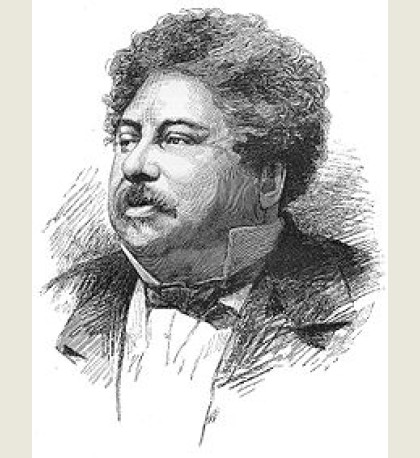
Alexandre Dumas was a French writer whose adventure novels made him one of the most widely read French authors in the world. He was also a playwright and journalist. Since his son also bore the name Alexandre and was also a writer, to avoid confusion he is often referred to with the уточнение “père” (“father”).
Alexandre Dumas was born in 1802 into the family of General Thomas-Alexandre Dumas and Marie-Louise Labouret, the daughter of an innkeeper in Villers-Cotterêts.
Dumas spent his childhood, adolescence, and youth in his native town. There he became friends with Adolphe de Leuven, his age mate, poet, and habitué of Paris theaters. Dumas decided firmly to become a playwright. With no money or connections, relying only on old friends of his father, he decided to move to Paris. The twenty-year-old Alexandre, who had no education (his only asset was his beautiful handwriting), was given a post at the Palais-Royal in Paris in the chancery attached to the Duke of Orléans, which was helped along by General Foy. Dumas set about making up for his lack of education. One of his acquaintances drew up a list of authors for Alexandre to read: it included works by the classics, memoirs, and chronicles. Dumas attended theaters in order to study the profession of a playwright, and at one performance he accidentally met Charles Nodier. Together with Leuven, who believed that success was easier to achieve in a lighter genre, Dumas wrote the vaudeville Hunting and Love, which was accepted for production by the Théâtre de l’Ambigu.
One day at one of the exhibitions of the annual Salon, Dumas noticed a bas-relief depicting the murder of Giovanni Monaldeschi. After reading articles about Monaldeschi and the Swedish Queen Christina in the Universal Biography, Dumas decided to write a drama on the subject. At first he proposed a collaboration to Soulié, but in the end each decided to write his own Christina. Dumas’s play pleased the royal commissioner at the Comédie-Française, Baron Taylor, and with his help Christina was accepted on condition that Dumas revise it. However,
Books



Didn't find the book you were looking for?
