Alexander Griboyedov
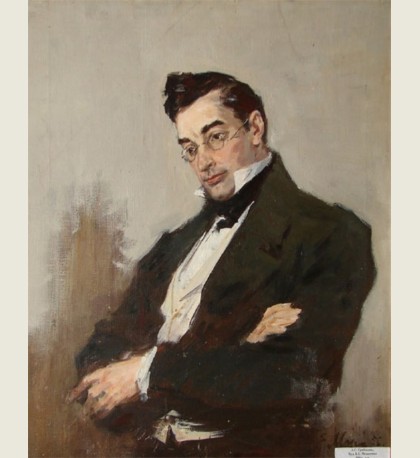
Alexander Sergeyevich Griboyedov was a Russian playwright, poet, diplomat, composer (two “Griboyedov Waltzes” have survived), and pianist. He was a state councillor (1828). He was born into a noble family.
In 1808 he graduated from the Department of Letters of Moscow University with the degree of candidate. He stood out for his broad interests, musical talent, and knowledge of European languages.
In 1814–1815 Griboyedov collaborated with the journals Vestnik Evropy and Syn Otechestva, publishing critical articles on literature and translations. In December 1817 Griboyedov was appointed secretary of the Russian diplomatic mission of A. P. Yermolov in Persia, and from early 1822 he was on his staff “in diplomatic matters.”
In 1823–1824, in Tiflis and Moscow, Griboyedov wrote the comedy Woe from Wit. Griboyedov was unable either to publish the comedy or to stage it. Its first performances, with extensive censorship cuts, took place in 1831 (the complete text of the comedy was first published in 1858 by A. I. Herzen abroad; in Russia it appeared in 1862). In 1824 Griboyedov was admitted as a member of the Free Society of Lovers of Russian Literature. In 1827 he was assigned responsibility for diplomatic relations with Persia and Turkey. With his active participation, on February 10, 1828, the favorable Treaty of Turkmenchay was concluded, ending the Russo-Persian War of 1826–1828.
In July 1828, in the rank of “plenipotentiary minister,” Griboyedov was sent to Persia to ensure compliance with the terms of the Treaty of Turkmenchay. During the Russo-Turkish War of 1828–1829, Griboyedov secured Persia’s neutrality.
On January 30, 1829, an attack on the Russian embassy in Tehran was provoked by the Persian authorities. A mob of Muslims, incited by fanatics, broke into the embassy building and slaughtered everyone there, including Griboyedov. The Russian
Books
Didn't find the book you were looking for?
