Aleksandr Ostrovskiy
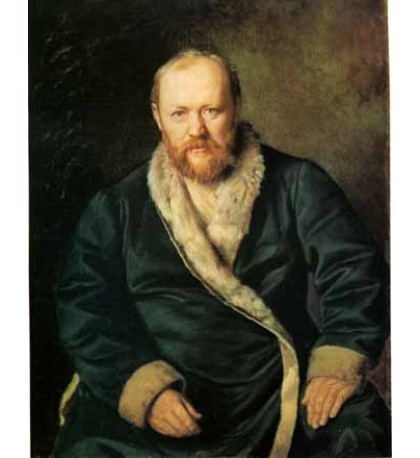
Alexander Nikolayevich Ostrovsky was a Russian dramatist whose work became a major stage in the development of the Russian national theater.
Ostrovsky’s father graduated from a theological academy, but served first in the civil chamber and then practiced private law. He acquired hereditary nobility. His mother, whom he lost in childhood, came from the lower clergy. He did not receive a systematic education. His childhood and part of his youth were spent in the center of Zamoskvorechye. Thanks to his father’s large library, Ostrovsky became acquainted early with Russian literature and felt an inclination toward writing, but his father wanted to make a lawyer of him. After completing the gymnasium course at the First Moscow Gymnasium in 1840 (he entered in 1835), Ostrovsky enrolled in the law faculty of Moscow University, but he was unable to complete the course (he studied until 1843).
At his father’s wish, he took a clerical job in a court. He served in Moscow courts until 1851; his first salary was 4 rubles a month, and after some time it rose to 15 rubles. By 1846 he had already written many scenes from merchant life and had conceived the comedy The Insolvent Debtor (according to other sources, the play was called A Picture of Family Happiness; later, It’s a Family Affair — We’ll Settle It Ourselves). Drafts for this comedy and the sketch Notes of a Zamoskvorechye Resident were published in one issue of the Moscow City Leaflet in 1847. The text bore the initials “A. O.” and “D. G.”, that is, A. Ostrovsky and Dmitry Gorev, a provincial actor who had proposed collaboration. The collaboration went no further than one scene, and later it became a source of great trouble for Ostrovsky, since it gave his detractors grounds to accuse him of appropriating another’s literary work. Ostrovsky gained literary fame with the comedy It’s a Family Affair — We’ll Settle It Ourselves!, originally titled Bankrupt, published in 1850. The play drew approving responses from N. V. Gogol and I. A. Goncharov. It was banned from stage production. Influential Moscow merchants, offended on behalf of their entire
Books
Didn't find the book you were looking for?
