Aleksandr Sergeevich Pushkin
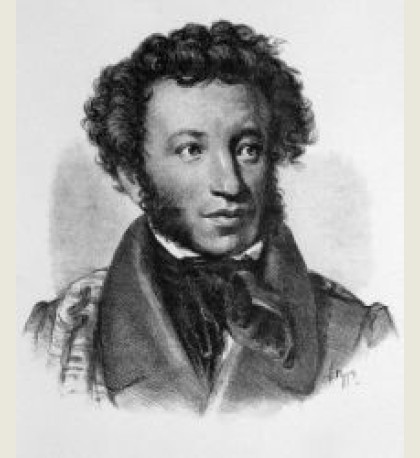
Alexander Sergeyevich Pushkin was a Russian poet, playwright, and prose writer who laid the foundations of Russian realism, as well as a literary critic and theorist, historian, and publicist; he was one of the most authoritative literary figures of the first third of the 19th century.
He was born on June 6 (May 26, old style), 1799, in Moscow, into a poor noble family whose ancestry, however, included boyars from the time of almost Alexander Nevsky and the “tsar’s Moor,” Abram Petrovich Gannibal. In the poet’s childhood, his uncle Vasily Lvovich Pushkin, who knew several languages, was acquainted with poets, and was himself involved in literary pursuits, had a major influence on him. Little Alexander was raised by French tutors; he learned to read early and began writing poetry in childhood, though in French; he spent the summer months at his grandmother’s estate near Moscow. On October 19, 1811, the Tsarskoye Selo Lyceum opened, and Alexander Pushkin became one of its first pupils. The six years at the Lyceum profoundly influenced him: he developed as a poet, as evidenced by the poem “Remembrance in Tsarskoye Selo,” highly praised by G. R. Derzhavin, and by his participation in the literary circle “Arzamas”; and the atmosphere of free thought and revolutionary ideas largely determined the civic stance later taken by many Lyceum graduates, including Pushkin himself.
After graduating from the Lyceum in 1817, Alexander Sergeyevich Pushkin was appointed to the College of Foreign Affairs. However, bureaucratic service interested the poet little, and he plunged into the lively life of St. Petersburg, joined the literary and theatrical society “The Green Lamp,” and composed poetry imbued with ideals of freedom as well as sharp epigrams. Pushkin’s largest poetic work was the poem “Ruslan and Lyudmila,” published in 1820 and provoking fierce controversy. His attacks on those in power did not go unnoticed, and in May 1820, under the guise of an official transfer, the poet was in effect exiled from the capital. Pushkin went to the Caucasus, then to Crimea, lived in Chisinau and Odessa, and met future Decembrists
Books
Didn't find the book you were looking for?
