Aleksey Tolstoy
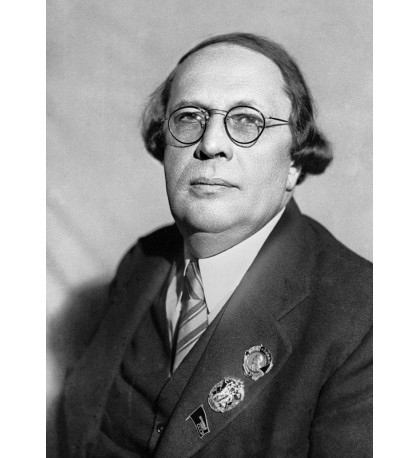
Aleksey Nikolayevich Tolstoy was a Russian Soviet writer, a count, and an academician of the USSR Academy of Sciences (1939). He was a member of the commission to investigate the atrocities of the German invaders (1942). He was the author of social-psychological, historical, and science-fiction novels, novellas and short stories, and journalistic works.
He was born on 29 December 1882 (10 January 1883, New Style) in the town of Nikolayevsk, Samara Governorate (now the town of Pugachyov in Saratov Oblast). His father was Count Nikolay Aleksandrovich Tolstoy (who, on his father’s side, was a distant relative of Leo Tolstoy), although some biographers attribute paternity to his unofficial stepfather, Aleksey Apollonovich Bostrom. His mother was Aleksandra Leontyevna (Lvovna), children’s writer A. L. Vostrom, née Turgeneva (a second cousin of the Decembrist N. I. Turgenev); by the time of A. N. Tolstoy’s birth, she had left her husband for A. A. Bostrom.
The future writer’s childhood was spent on the small estate of A. A. Bostrom at the Sosnovka farmstead, near Samara (now the settlement of Pavlovka, Krasnoarmeysky District).
In the spring of 1905, while a student at the Saint Petersburg Technological Institute, Aleksey Tolstoy was sent for practical training to the Urals, where he lived in Nevyansk for more than a month. Later, in the book The Best Journeys through the Middle Urals: Facts, Legends, Traditions, he dedicated his very first story, “The Old Tower,” to the Nevyansk leaning tower. During the First World War, he worked as a war correspondent. He traveled to France and England in 1916.
After the October Revolution, in 1918–1923, Aleksey Tolstoy lived in emigration (Constantinople, Berlin, Paris). In 1927 he took part in the collective novel Big Fires,
Books


Didn't find the book you were looking for?
