Ales Adamovich
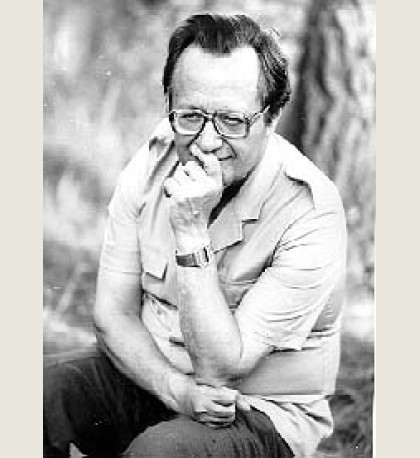
Ales Adamovich (1927–1994) was a Belarusian writer, scholar, screenwriter, and public figure; one of the major voices of 20th-century antiwar literature. He was a Doctor of Philology, a corresponding member of the Academy of Sciences of the BSSR, and a deputy of the Supreme Soviet of the USSR.
He was born in the village of Kanyukhi near Kopyl and spent his childhood in the workers’ settlement of Glusha in the Bobruysk region. The war caught up with him as a teenager: at fourteen, together with his mother and brother, he took part in the anti-fascist underground, and later fought as an ordinary soldier in the Kirov Partisan Detachment. His mother, the head of the local pharmacy, supplied the partisans with medicine and carried out underground assignments. When he went into the forest, Adamovich replaced a loaf of bread in his knapsack with a one-volume edition of Pushkin. The war left a mark on him and became the source and meaning of all his subsequent творчество.
After the war, he graduated from the Faculty of Philology of Belarusian State University and defended his doctoral dissertation. He taught at Moscow State University, but in 1966 he was forced to leave Moscow and return to Minsk after refusing to sign a letter condemning the dissident writer Andrei Sinyavsky. This act says much about Adamovich’s character: he consistently refused compromise where human dignity was concerned.
The central theme of his prose is the human being at war, people’s behavior in extreme circumstances, and the antihuman nature of fascism and collaborationism. The dilogy War Beneath the Roofs and The Sons Go to Battle (1960–1963) is an autobiographical partisan epic based on his own wartime experience and his mother’s life. The Khatyn Story (1972) is a powerfully moving account of burned Belarusian villages, written so that the reader is inside the tragedy, not outside it. The novel The Executioners (1981) is an attempt to understand the psychology of executioners from within, one of the harshest antiwar texts in Soviet literature.
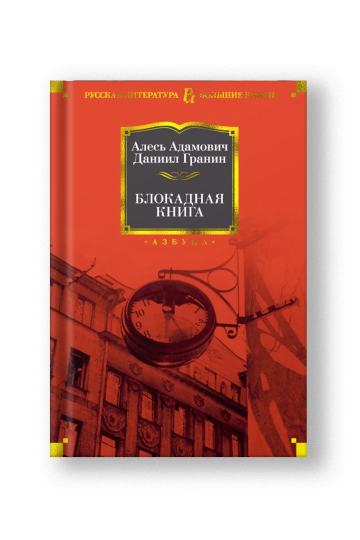
The pinnacle of his documentary prose was
Books

Didn't find the book you were looking for?
