Maksim Bahdanovich
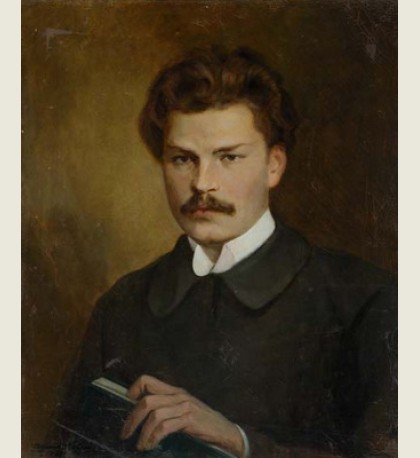
Maxim Bogdanovich was born on December 9, 1891, in Minsk. His father, Adam, a well-known ethnographer, folklorist, and linguist, graduated from the Nesvizh Teachers’ Seminary and worked in Minsk as the head of the city’s First Primary School. His mother, Maria, a teacher by education, studied at the Zemstvo Teachers’ School in St. Petersburg.
In the summer of 1892, the Bogdanovich family moved to Hrodna. Here, alongside his mother and brothers Vadim and Lyova, Maxim spent the happiest years of his childhood. In 1896, when she was 27, his mother died; his father was transferred to Nizhny Novgorod, where in 1902 Maxim entered the first grade of the Nizhny Novgorod boys’ gymnasium.
The materials from the newspapers Nasha Niva and Nasha Dolya, which he became acquainted with during his gymnasium years, had a significant influence on the formation of his worldview. He studied the Belarusian language and literature. The idea of the national rebirth of his homeland became the goal and meaning of his life.
Maxim Bogdanovich’s creative activity began with the publication of the allegorical story “The Musician” (Nasha Niva. 1907. No. 24. July 6). In 1908, his first poems, “Spring Will Come” and “Over the Grave,” were written and published; the author indicated the place of writing as Nizhny Novgorod.
In June 1908, the Bogdanovich family moved permanently to Yaroslavl. Maxim was transferred to the sixth grade of the Yaroslavl gymnasium. In the spring of 1909, the young man fell ill with tuberculosis. Despite his illness, the gymnasium years were productive creatively. The newspaper Nasha Niva periodically printed his poems, while the newspaper Golos published notes, reviews, feuilletons, and critical articles.
In 1909, Adam Bogdanovich took his son to Crimea for treatment. His fascination with the southern land, a new circle of acquaintances, and falling in love—all this influenced the young man’s romantic mood. His health improved.
In 1909, S
Books

Didn't find the book you were looking for?
