Chingiz Aytmatov
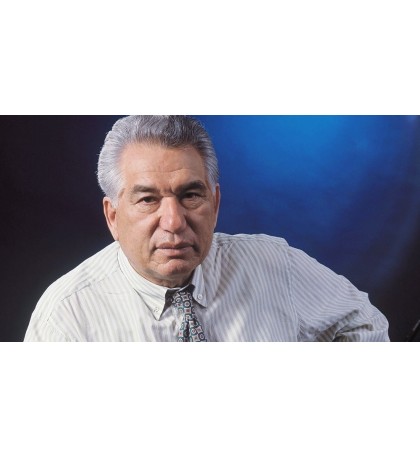
Chingiz Aitmatov was a Kyrgyz writer.
He was born on December 12, 1928, in the village of Sheker, now in Kyrgyzstan’s Talas Region. His father, Torekul Aitmatov, was a prominent statesman of the Kirghiz SSR, but in 1937 he was arrested and in 1938 was executed. Chingiz, his brothers, and sisters grew up in Karakol, in the house of their grandfather, the Tatar first-guild merchant Khamsa Abdulvaliev. His mother, Nagima Abdulvalieva, was a Komsomol worker and a Soviet employee.
After completing eight grades, he entered the Zhambyl Zootechnic School, which he graduated from with honors. In 1948 Aitmatov entered the Agricultural Institute in Frunze, from which he graduated in 1953. In 1952 he began publishing short stories in Kyrgyz in the periodical press. After graduating from the institute, he worked for three years at a research institute for livestock breeding, while continuing to write and publish stories. In 1956 he entered the Higher Literary Courses in Moscow (graduating in 1958). In the year he completed the courses, his story “Face to Face” was published in the magazine Oktyabr. In the same year his stories were published in the magazine Novy Mir, and the novella Jamilya was also published, bringing Aitmatov worldwide fame. Thus the name of Chingiz Aitmatov appeared on the horizon of world literature as a powerful socio-cultural phenomenon. In this way he became a colossus of Kyrgyz literature.
After Jamilya, the novellas The Camel’s Eye (1960), The First Teacher (1961), Mother’s Field (1963), and the collection Tales of the Mountains and Steppes (1963), for which the writer received the Lenin Prize, were also published. All these works appeared simultaneously in Russian and Kyrgyz. In 1965 the novella The First Teacher was adapted for film by Andrei
Books


Didn't find the book you were looking for?
