Dumbadze Nodar
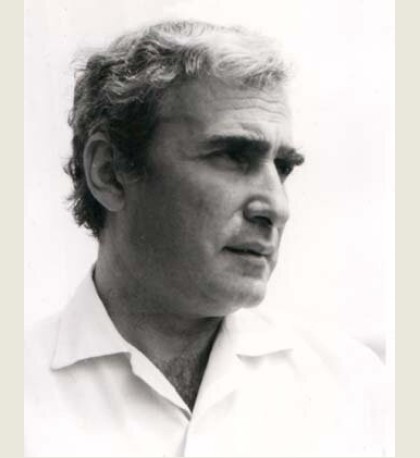
Nodar Vladimirovich Dumbadze was a Soviet Georgian writer and recipient of the Lenin Komsomol Prize (1966) and the Lenin Prize (1980).
He was born on 14 July 1928 in Tbilisi. His childhood was overshadowed by the political events of the 1930s and then by the war. His parents were arrested in 1937 (his father was a district party committee secretary), and the little boy’s difficult life as the son of “enemies of the people” began (his parents were rehabilitated only in 1956). He grew up in western Georgia, in the village of Khidistavi, with relatives. After graduating from school in the village, he entered the Faculty of Economics of Tbilisi State University (which in those years bore the name of I. V. Stalin). He graduated in 1950. After working for several years at the university as a laboratory assistant, from 1957 he devoted himself entirely to literary work: he worked (in 1957) in the editorial office of the journal Tsiskari (“Dawn”), was deputy editor of the humorous magazine Niangi (“Crocodile,” 1957–1962), worked in the screenplay department at Georgia-Film (1962–1965), and was editor of Niangi (1965–1973). From 1973 he was secretary, and from 1981 until his death, chairman of the board of the Writers’ Union of Georgia. Having gained enormous popularity from the very beginning of his literary career, he was repeatedly honored with awards: he received the Rustaveli Prize (1975), the Lenin Komsomol Prize (1966), and the Lenin Prize (1980). He was a deputy of the Supreme Soviet of the Georgian SSR for two convocations (1971–1978) and of the Supreme Soviet of the USSR (1979–1984).
His first poems were published in 1950 in the university almanac The First Ray. In 1956–1957 three books of humorous stories appeared, immediately attracting attention to him, but true fame and recognition came with the novel Me, Grandma, Iliko and Illarion, published in 1960. Soon afterward, a play based on the novel was written in collaboration with G. Lordkipan
Books

Didn't find the book you were looking for?
