Dzhonatan Svift
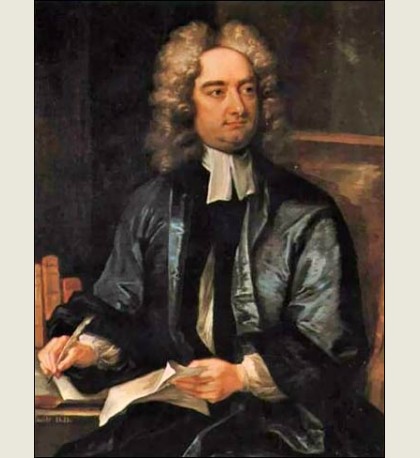
Jonathan Swift was an Irish satirical writer, publicist, poet, and public figure. He is best known as the author of the fantasy tetralogy Gulliver’s Travels, in which he wittily ridiculed human and social vices.
He was born in Dublin to an English family in 1667. As a cousin of the poet John Dryden, Swift studied at Trinity College. There he got into trouble for breaking discipline. Later Swift became secretary to Sir William Temple. While in his service, Swift wrote his first major satirical works — The Battle of the Books and A Tale of a Tub, which were published in 1704. Around the same time, he fell in love with Esther (Stella) Johnson, whom he later probably married secretly.
When Temple died in 1699, Swift became a clergyman and received a parish in Ireland. He often traveled to England, where he became seriously involved in politics and literature. Although Swift was initially a Whig, in 1710 he switched to the Tories, and three years later became dean of St. Patrick’s Cathedral.
In Gulliver’s Travels, Swift’s satirical talent found its fullest expression. His passionate love of language resulted in the invention of dialects for all the unknown lands visited by Gulliver. His interest in politics found reflection in the satire on intrigues in the English government (the description of the court in Lilliput). His distrust of theoretical science was expressed in the satirical portrayal of the Grand Academy in Lagado, a parody of the Royal Society of England.
Despite the fact that Swift is known to have been sarcastic about human nature, he was apparently a pleasant person. He was on friendly terms with the literary luminaries of the time: Alexander Pope, John Arbuthnot, and John Gay — and together with them founded the Scriblerus Club. Swift also became a true hero to the Irish, in whose defense he published several sharp satirical works, the best known of them being A Modest Proposal.
In the last years of his life, Swift suffered from a progressive mental disorder. Nothing reflects Swift’s character better than the epitaph he wrote for himself: <
Books
Didn't find the book you were looking for?
