Erazm Rotterdamskiy
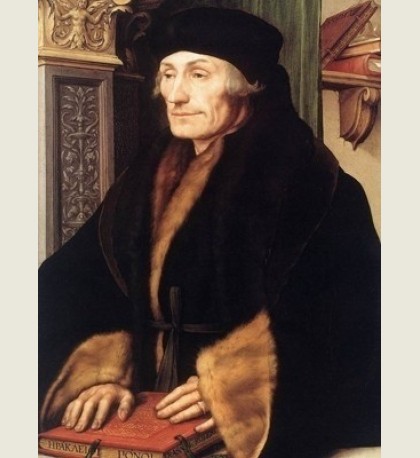
Desiderius Erasmus, also Erasmus of Rotterdam, or simply Erasmus (Lat. Desiderius Erasmus Roterodamus, Dutch Gerrit Gerritszoon) was the greatest scholar of the Northern Renaissance, nicknamed the “prince of humanists.” He prepared the first edition of the Greek original of the New Testament with commentary and initiated the critical study of the text of Holy Scripture. He helped restore the literary heritage of antiquity to cultural use. He wrote primarily in Latin. Having gained all-European fame for his freedom-loving views, Erasmus did not accept the Reformation and in the last years of his life engaged in sharp controversy with Luther over the doctrine of free will (which many Protestants called into question).
He was born in Rotterdam, Holland. Orphaned early, he entered an Augustinian monastery (1487) and was soon ordained (1492). However, in 1494 he obtained permission to leave the monastery and became an independent scholar. For some time Erasmus lived in France, visited England, where he became close to Thomas More, and worked in the Aldine Press. In Italy he was awarded a doctorate in theology. Erasmus’s activities won the approval of the pope. In these years the entire educated world began to heed the scholar-humanist. “Everyone who does not wish to be considered a stranger in the realm of the Muses,” wrote Cammerarius, “marvels at him, sings his praises, and exalts him.” When Luther began his struggle, Erasmus found himself in a difficult position. On the one hand, he sympathized with the idea of reforming the Church, but on the other, he condemned the religious and political strife brought about by the Reformation. Erasmus could not align himself wholly with Luther’s opponents either, which aroused indignation in the Catholic camp. Erasmus spent the last years of his life wandering through Europe, which was engulfed in civil strife. He died in Basel while working on a commentary on Origen.
A champion of humanity, enlightenment, and tolerance, Erasmus opposed the evangelical ideal to fanaticism, obscurantism, and clericalism. In his famous satire “In Praise of Folly” (1509; Russian trans.: BVL, 1971, vol. 33), written in Thomas More’s house, Erasmus выступ
Books
Didn't find the book you were looking for?
