Fransua-Mari Arue Volter
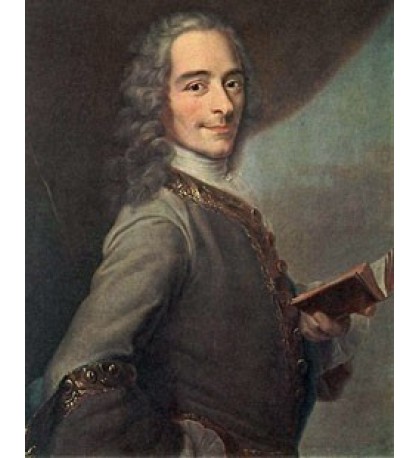
Voltaire was one of the greatest French Enlightenment philosophers of the eighteenth century, a poet, prose writer, satirist, historian, publicist, and human rights advocate; the founder of Voltairianism.
The son of Judge François-Marie Arouet, Voltaire studied at a Jesuit college “Latin and all sorts of nonsense,” and was destined by his father for the legal profession, but he preferred literature to law; he began his literary career in the palaces of aristocrats as a poet retained for their amusement; for satirical verses aimed at the regent and his daughter he was sent to the Bastille (where he was later confined a second time, this time for someone else’s verses); he was beaten by a nobleman whom he had ridiculed and wanted to challenge him to a duel, but because of the offender’s intrigue he again found himself in prison and was released on condition that he leave the country; he went to England, where he lived for three years (1726–1729), studying its political system, science, philosophy, and literature.
After returning to France, Voltaire published his impressions of England under the title Philosophical Letters; the book was confiscated (1734), the publisher paid for it with imprisonment in the Bastille, and Voltaire fled to Lorraine, where he found refuge with the Marquise du Châtelet (with whom he lived for 15 years). Accused of mocking religion, Voltaire fled again, this time to the Netherlands.
In 1746 Voltaire was appointed court poet and historiographer, but after arousing the displeasure of Madame de Pompadour, he broke with the court. Forever suspected of political unreliability and not feeling safe in France, Voltaire accepted (1751) an invitation from the Prussian king Frederick II, with whom he had long been in correspondence (since 1736), and settled in Berlin (Potsdam), but after incurring the king’s displeasure through dubious financial speculations and a quarrel with the president of the Academy, Maupertuis, he was forced to leave Prussia and settled in Switzerland (1753). There he bought an estate near Geneva, renaming it “Les Délices,” and then acquired two more estates: Tournay and, on the French border,
Books
Didn't find the book you were looking for?
