Stendhal
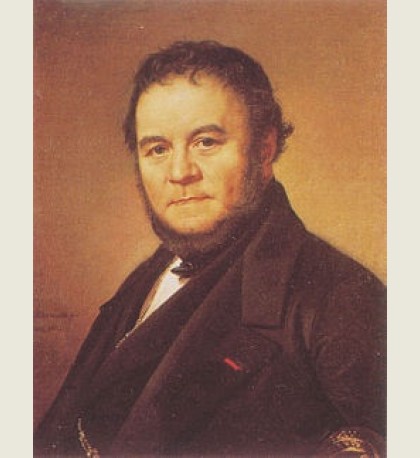
Stendhal (real name Henri-Marie Beyle) was a French writer.
Henri-Marie Beyle was born on January 23, 1783, in the small French town of Grenoble, in the family of the lawyer Cherubin Beyle. Henriette Beyle, the writer’s mother, died when the boy was seven years old. For this reason, he was raised by his aunt Séraphie and his father. Little Henri did not get along with them. Only his grandfather Henri Gagnon treated the boy warmly and attentively. Later, in his autobiography Life of Henry Brulard, Stendhal recalled: “I was entirely brought up by my dear grandfather, Henri Gagnon. This extraordinary man, in his time, made a pilgrimage to Ferney to see Voltaire, and was very well received by him…” Henri Gagnon was an admirer of the Enlightenment thinkers and introduced Stendhal to Voltaire, Diderot, and Helvétius. From that time on, Stendhal developed a negative attitude toward clericalism. Because in childhood Henri had encountered the Jesuit Ryan, who forced him to read the Bible, he felt fear and distrust toward the clergy all his life.
While studying at the Central School in Grenoble, Henri followed the course of the Revolution, although he scarcely understood the importance of its significance. He studied at the school for only three years, mastering, by his own admission, only Latin. In addition, he was fascinated by mathematics and logic, studied philosophy, and the history of art.
In 1799, Henri went to Paris with the intention of entering the Polytechnic School. But instead, inspired by Napoleon’s coup, he entered the active army. He was enrolled as a sub-lieutenant in a dragoon regiment. However, in 1802 he resigned and spent the following three years in Paris, engaged in self-education and studying philosophy, literature, and English. Then he served in the commercial administration in Marseille, and in 1805 returned to military service. As a military official in Napoleon’s army, Henri traveled in Italy, Germany, and Austria. During campaigns he found time for reflection and wrote notes on painting and music. He filled thick notebooks with his notes. Some of these notebooks were lost during the crossing of the Berezina.
Books
Didn't find the book you were looking for?
