Fridrikh Nitsshe
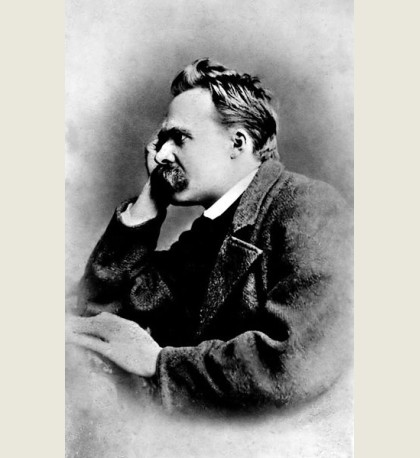
Friedrich Nietzsche was a German thinker, classical philologist, and the creator of a distinctive philosophical doctrine that is emphatically nonacademic in character and therefore has enjoyed wide circulation far beyond the scientific and philosophical community.
He was born on 15 October 1844 in Röcken, near Leipzig, into the family of the Lutheran pastor Karl Ludwig Nietzsche.
While studying at gymnasium, he showed talent in philology and music. He is credited with 73 musical compositions. He stopped composing music at the age of 29 after being criticized by leading musicians of his time, Hans von Bülow (for the piano piece “Manfred Meditating”) and Richard Wagner (for the piece “Echo of New Year’s Night”).
From 1864 to 1869 Nietzsche studied theology and classical philology at the universities of Bonn and Leipzig. During this period he became acquainted with Schopenhauer’s works and became an admirer of his philosophy. Nietzsche’s development was also influenced by his friendship with Richard Wagner, which lasted three years. When the Franco-Prussian War began, he wanted to go to the front, but since he lived in a neutral country — Switzerland — he could go there only as a medical orderly. From the wounded he contracted many illnesses, in particular diphtheria and dysentery.
Nietzsche was a brilliant student and gained an excellent reputation in scholarly circles. Thanks to this, in 1869, at the age of 25, he already obtained the position of professor of classical philology at the University of Basel. With interruptions for illness and participation in the Franco-Prussian War, he worked there for about 10 years. At that time Nietzsche was a cosmopolitan, since at the very beginning of his professorial career he demonstratively renounced Prussian citizenship.
In 1879 Nietzsche was forced to resign for health reasons (he was almost blind and suffered from intolerable headaches, which he treated with opiates, as well as stomach problems). From 1879 to 1889 he led the life of an independent writer, moving from city to city, and during this period created all of his major works. Nietzsche usually spent summers in Switzerland (in the vicinity of Mount St. Moritz, Graubünden) and winters in the Italian cities of Genoa, Turin, and Rapallo
Books

Didn't find the book you were looking for?
