Hans Christian Andersen
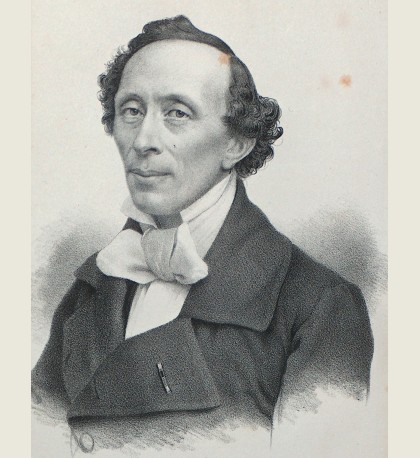
Hans Christian Andersen was a Danish writer and poet.
He was born on April 2, 1805, in Odense on the Danish island of Funen. Andersen’s father, Hans Andersen, was a poor shoemaker, and his mother, Anna Marie Andersdatter, was a washerwoman from a poor family; in childhood she had to beg for alms, and she was buried in a pauper’s cemetery.
In 1816 Andersen’s father died, and the boy had to work for his living. He was an apprentice first to a weaver, then to a tailor. Later Andersen worked at a cigarette factory. In early childhood Hans Christian was a reserved child with large blue eyes, who sat in a corner and played his favorite game: the puppet theater. This was the only pastime he kept in his youth as well.
At the age of 14 Andersen went to Copenhagen; his mother let him go because she hoped he would stay there a little while and then return. When she asked why he was leaving her and home, the young Andersen immediately replied, “To become famous!” He went with the aim of finding work in the theater, motivated by his love for everything connected with it. He received money on a letter of recommendation from a colonel in whose family he had staged his performances as a child. During the year he lived in Copenhagen, he tried to get into the theater. First he went to the home of a famous singer and, overcome with emotion and in tears, asked her to get him into the theater. She, just to get rid of the persistent, strange, gangly teenager, promised to arrange everything, but of course did not keep her promise. Much later she would tell Andersen that at the time she had simply taken him for a madman.
Hans Christian was a gangly adolescent with elongated, thin limbs and neck, and the same long nose; he was the very quintessence of the “ugly duckling.” But thanks to his pleasant voice, and also out of pity, Hans Christian, despite his unremarkable appearance, was accepted into the Royal Theater, where he played minor roles. He was used less and less, and then his voice changed with age, and he was dismissed. In the meantime, Andersen composed a play in five acts and wrote a letter to the king, persu
Books




Didn't find the book you were looking for?
