Genrik Ibsen
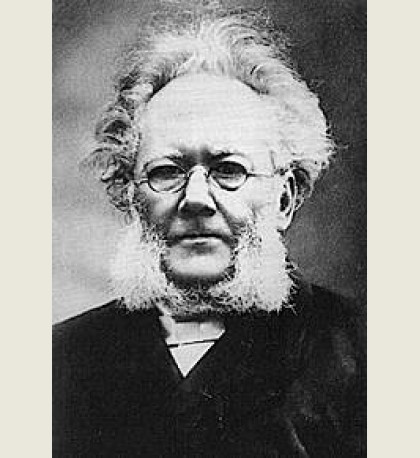
Henrik Ibsen was an outstanding Norwegian playwright and the founder of the European “new drama.” He also worked in poetry and journalism. He was born into the family of a wealthy merchant who went bankrupt in 1836. He wrote in Danish (in its Norwegian variant), which in his time was the literary language of Norway.
Beginning in 1844, he worked as a pharmacist. At that time he wrote his first poems and the drama from ancient Roman history, Catiline (1850), whose motifs reflect the revolutionary events of 1848 in Europe. The drama was published under a pseudonym and was not successful. In 1850, Ibsen’s play The Burial Mound was staged in Christiania. In 1852–1857 he directed the first national Norwegian theater in Bergen, and in 1857–1862 he headed the Norwegian Theater in Christiania. The Bergen period of his life coincided with the writer’s fascination with political nationalism and Scandinavian folklore. This produced the “medieval” plays Lady Inger of Oestraat (1854), The Feast at Solhaug (1855), Olaf Liljekrans (1856), and The Vikings at Helgeland (1857). In 1862 Ibsen wrote Love’s Comedy, in which a satirical picture of bourgeois and bureaucratic Norway was outlined. In the folk-historical drama The Pretenders (1864), Ibsen showed the victory of a hero who fulfills a progressive historical mission. However, both literary reasons (the impossibility of fully depicting human relationships with the help of medieval images and romantic clichés) and extra-literary ones (disillusionment with nationalism after the Austro-Prussian-Danish War) prompted Ibsen to go abroad in search of new forms.
Ibsen spent a quarter of a century abroad, living in Rome, Dresden, and Munich. His first plays to gain worldwide fame were the verse dramas Brand (1865) and Peer Gynt (1867). They illustrate the opposite traits of Ibsen himself, as well as those of his contemporary. The
Books

Didn't find the book you were looking for?
