Georgiy Millyar
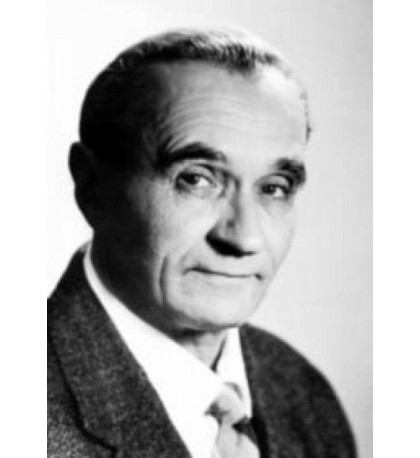
Georgy Frantsevich Millyar was a Soviet and Russian theater and film actor, whom he himself described as “the entire unclean force of our cinema.” He was a People’s Artist of the RSFSR.
Georgy Millyar was born on November 7, 1903, in Moscow, into the family of François de Milyeu, a French bridge engineer from Marseille who had come to Russia for work, and Yelizaveta Alekseyevna Zhuravlyova, the daughter of an Irkutsk gold miner. The boy’s childhood was spent in luxury. But his father died early, in 1906 in Yalta, when his son was not yet three years old. Even before the start of the First World War, the widow de Milyeu moved from Moscow to Gelendzhik. After 1917 the family was left without relatives and without money; the apartment in Moscow and the house in Gelendzhik were confiscated. The particle “de” was prudently removed from the altered surname, and Georgy Frantsevich never listed his knowledge of foreign languages on questionnaires, although he spoke French and German fluently. He worked as a prop man in the Gelendzhik theater, but, dreaming of the stage, learned all the roles. The actor made his debut in the play Cinderella. The actress playing the title role fell ill, and Millyar replaced her. The unexpected debut was successful, and the young Millyar was given another duty — to be a “first-aid service.” Thus, in 1920, Georgy Frantsevich’s acting career began with a female role. In 1924, already a well-known provincial actor, he entered the School for Juniors at the Moscow Theater of the Revolution (now the Mayakovsky Theater). Millyar took part in many productions that remained forever in the memory of Moscow theatergoers: Duke Albano (“The Lake of Lyul”), Mokronosov (“The End of Krivorylsk”), Pikel (“Hey, We’re Alive”), the pharmacist (“Romeo and Juliet”), the attaché (“Golgotha”), Boltikov (“Inga”), Imanguzha (“Poem about the Axe”), Mr. Gawker (“Street of Joy”), Count Ludovico (“The Dog in the Manger
Books


Didn't find the book you were looking for?
