Ivan Goncharov
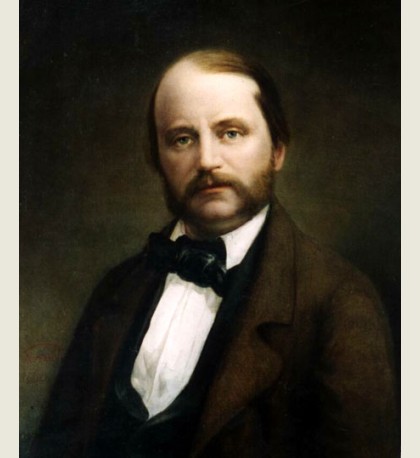
Ivan Alexandrovich Goncharov was a Russian writer; a corresponding member of the St. Petersburg Academy of Sciences in the category of Russian language and literature (1860), and a full state councillor.
Ivan Goncharov was born on June 6, 1812, Old Style, June 18, New Style, in Simbirsk, the youngest son in the family of a wealthy merchant. Two sisters were born after him. The boy lost his father early, at the age of seven. His main mentor became his godfather, the retired sailor Nikolai Nikolayevich Tregubov. They lived in one house. As Goncharov himself wrote, the material side, that is, the management of the vast estate, fell to his mother, Avdotya Matveyevna, while the spiritual side—the upbringing of the godson—fell to Tregubov. Thus, Ivan Alexandrovich received his first education first from his godfather, then at a private boarding school run by a priest, and at the age of ten he began studying in Moscow. The future writer’s mother insisted on his entering a commercial school.
Goncharov studied in the commercial track for eight years and recalled those years with disgust. The director of the school was a careerist; he was not interested in what went on in the classrooms as long as there was silence. Among the teachers were drunkards, ignoramuses, sadists, and deranged old men. Great care was taken to ensure that the students read as little as possible—ideally, nothing except what was related to the lessons. The teenage Goncharov devoured Karamzin and Pushkin... Only when he turned eighteen did his mother relent and take him out of the hated institution.
So the young man had no ambitions to become a businessman. He was drawn in a completely different direction. In August 1831, Ivan Alexandrovich entered the faculty of letters at Moscow University, where he spent three years. Studying there at the same time were Belinsky, Herzen and Ogaryov, Stankevich, Turgenev, and Konstantin Aksakov. In 1832, Goncharov was first published in a magazine, translating an excerpt from the novel Atar-Gul by the then-popular Eugène Sue.
Books
Didn't find the book you were looking for?
