Karin Boye
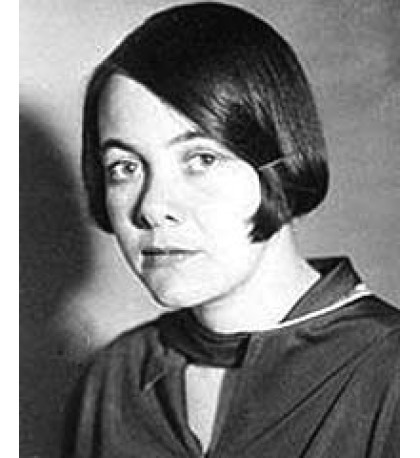
Karin Boye (Swedish: Karin Maria Boye) was a Swedish writer.
Karin’s father was an engineer and later an insurance agent, while her mother worked as an employee in the same company as her father. Her father suffered from mental instability, so Karin was raised by her mother. In 1909 the family moved to Stockholm. Karin studied at Uppsala University from 1921 to 1926; in 1922 her first poetry collection, Clouds, was published. In the 1920s she belonged to the socialist group Clarté. She translated Thomas Mann’s novel The Magic Mountain (1929). In 1931 Boye became one of the founders of the poetry magazine Spektrum, translated T. S. Eliot, and promoted surrealism.
In 1930 she visited the USSR; in 1932-1933 she lived in Berlin, after which she wrote the dystopian novel Kallocain (1940), which became her best-known work and was repeatedly reissued and translated into many languages.
Several romances with men did not bring her happiness. In 1941 a love triangle formed in Karin’s life: Karin lived in the same house with the German émigré Margot Hanel, but she was in love with another woman, Anita Nathorst, who was dying of cancer and offered Karin only friendship. The emotional torment drove Karin to leave the house and go into the forest, where, according to the Gothenburg regional archives, she was found dead near a large stone on a hill north of the town of Alingsås. It is generally believed that she took her own life: a bottle of sleeping pills was found on her. A month after the tragedy, Margot Hanel also took her own life, and three months later Anita Nathorst died.
Karin Boye had a profound influence on Scandinavian poetry. Inger Hagerup, Harry Martinson, and Hjalmar Gullberg dedicated poems to her memory. In 1983 the Karin Boye Society was founded in Sweden. In 2004 the library of Uppsala University was named after her.
Books


Didn't find the book you were looking for?
