Karl Sagan
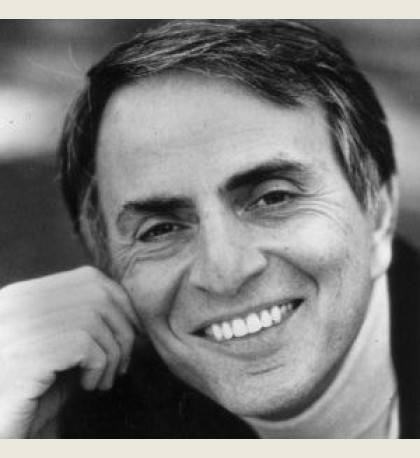
Carl Edward Sagan was an American astronomer, astrophysicist, and an outstanding science popularizer.
Sagan was a pioneer in the field of exobiology and gave impetus to the development of the Search for Extraterrestrial Intelligence (SETI) project. He gained worldwide fame for his popular science books and the television miniseries Cosmos: A Personal Voyage. He was also the author of the novel Contact, which was adapted into a film of the same name in 1997.
Carl Sagan was born in Brooklyn, New York, into a family of Russian-Jewish origin: the tailor Sam Sagan and the homemaker Rachel Molly Gruber. In 1951, Sagan entered the University of Chicago, where he received his bachelor’s degree in 1955. In 1956, he earned a master’s degree in physics, and in 1960 he defended his doctoral dissertation in astronomy and astrophysics.
From 1960 to 1962, Sagan worked as an assistant at the Yerkes Observatory of the University of Chicago, the University of California, Berkeley, and Stanford University.
From 1962 to 1968, Carl Sagan taught astronomy at Harvard University. In 1968, he moved to Cornell University. In 1971, Sagan became professor of astronomy and space studies, as well as director of the Laboratory for Planetary Studies.
Scientific achievements Sagan was among the first to hypothesize that Saturn’s moon Titan and Jupiter’s moon Europa might have oceans (it was assumed that Europa’s ocean lay beneath an icy surface) or lakes. He suggested that Europa’s water ocean could be habitable. Confirmation of the existence of a subsurface ocean on Europa was obtained indirectly with the help of Galileo.
Sagan also made significant contributions to the study of the atmosphere of Venus, seasonal changes on Mars, and Saturn’s moon Titan. He established that Venus’s atmosphere is extremely hot and dense. He also noted that global warming is an artificial danger created by humans and drew a parallel between this phenomenon and Venus’s natural transformation into a hot, uninhabitable planet through greenhouse gases. He hypothesized that seasonal changes on Mars are the result of dust storms rather than processes associated with
Books

Didn't find the book you were looking for?
