Juan Filloy
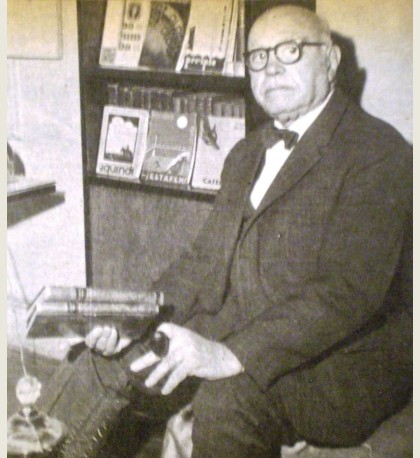
Juan Filloy was an Argentine writer and poet. At different times he was also a swimmer and a boxing referee. He was a polyglot who spoke seven languages. He spent most of his life in Río Cuarto, where he served as a justice of the peace.
Juan Filloy was born in 1894 into a family of immigrants: a laundress and healer from Toulouse and a Spanish peasant, both illiterate but determined to ensure that their son could attend school.
Although he never played football, in 1913 he was one of the founders of the Talleres club, an organization he eventually headed. In 1918 he took an active part in the university reform, which roughly coincides with the period when he worked as a draftsman-cartoonist. He was a member of the Argentine Boxing Federation and managed fights involving Luis Ángel Firpo.
In 1920, after being admitted to practice law by the National University of Córdoba, he moved to Río Cuarto, the city where he lived for 64 years. In his adopted city he was one of the founders of the Río Cuarto Museum of Fine Arts and the golf club (a sport he never played). For sixty years he collaborated with the Río Cuarto daily El Pueblo, in which he wrote a daily column filled with commentary on the news and literary or theatrical criticism. After publishing his first seven self-published books, he spent more than 28 years (between 1939 and 1967) without new publications. During this time he carried out his duties as a judge, while nevertheless continuing to write extensively. From 1984 he returned to the city of Córdoba, where he lived until his death.
His work, which includes collections of poems, plays, and short stories, “opened the door to a new American literature” (Alfonso Reyes).
He was an important source of inspiration for other writers, such as Julio Cortázar, who refers to his works in Rayuela (Mareel, 1979) and Vuelta al día en ochenta mundos (“Around the Day in Eighty Worlds”). His work is mainly characterized by criticism of human manners, a criticism carried out through humor and frequent recourse to parody and irony.
<Books

Didn't find the book you were looking for?
