Kuang Rebekka
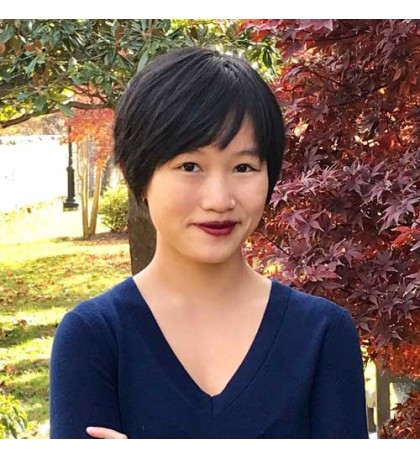
Rebecca Kuang is an American writer and translator of Chinese origin.
She was born in the Chinese city of Guangzhou, in Guangdong Province. Her mother grew up on Hainan Island, and her maternal grandfather fought for Chiang Kai-shek; Rebecca’s father grew up in Leiyang, Hunan Province, where he and his parents lived through the Japanese occupation. When Rebecca was four, the family moved to the United States, so the future writer grew up in Dallas, Texas. After graduating from school in 2013, she entered Georgetown University, which attracted her with its famous debate club. And although she had enjoyed inventing stories since early childhood, a degree in literature did not seem to her a reliable way to obtain a well-paid position in the future.
Kuang began writing her first novel, The Poppy War, which launched the trilogy of the same name, during a vacation while working as a debate coach in China in 2015. In total, the book took three years to complete, during which Rebecca managed to finish several prestigious literary courses that were specifically helpful for writing, Georgetown University, and then Cambridge University, where she earned a Master of Philosophy degree in Chinese studies. Kuang later received a master’s degree in modern Chinese studies at Oxford and returned to the United States in 2020 to pursue a doctorate in East Asian languages and literature at Yale University, by which time she was already the author of three global bestsellers.
The Poppy War trilogy is set in a fantasy world reminiscent of medieval China. At the center of the plot is a girl named Rin, who against her family’s wishes takes the exams for a military academy. There she studies shamanism — the ancient mystic art of controlling spirits. Later she joins a unit of shamanic cike, who serve the Empress in a war against foreigners. And very quickly Rin realizes how horrific real war is, and that it can be stopped only in a single way. The trilogy contains references to various stages of Chinese history, including the Sino-Japanese War, the Civil War, and the Opium Wars. Also associated with the cycle is the story “The Drowning Faith,” which is essentially a collection of scenes from the first two novels of the trilogy and the opening scene of the final novel, written from Nezha’s point of
Books
Didn't find the book you were looking for?
