Lev Gumilev
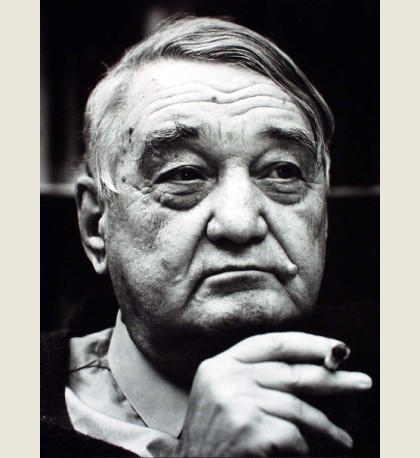
Lev Nikolayevich Gumilyov was a Soviet and Russian scholar, historian-ethnologist, Doctor of Historical and Geographical Sciences, poet, translator from Persian, and the founder of the passionary theory of ethnogenesis.
He was born in Tsarskoye Selo on October 1, 1912. He was the son of the poets Nikolai Gumilyov and Anna Akhmatova. As a child, he was raised by his grandmother at the Slavnoye estate in Tver Oblast.
From 1917 to 1929 he lived in Bezhetsk. Since 1930 he lived in Leningrad. In 1930–1934 he worked on expeditions in the Sayan Mountains, the Pamirs, and Crimea.
In 1934 he began studying at the Faculty of History of Leningrad University. In 1935 he was expelled from the university and arrested, but released some time later. In 1937 he was reinstated at Leningrad State University.
In March 1938, while a student at Leningrad State University, he was arrested again and sentenced to five years. He served his term in Norillag, working as a geological technician in a copper-nickel mine; after completing his sentence he was left in Norilsk without the right to leave.
In the autumn of 1944 he voluntarily joined the Soviet Army, fought as a private on the First Belorussian Front, and ended the war in Berlin.
In 1945 he was demobilized and reinstated at Leningrad State University, from which he graduated in early 1946 and entered postgraduate studies at the Leningrad Branch of the Institute of Oriental Studies of the USSR Academy of Sciences, from which he was expelled on the grounds of “inadequate philological training for the chosen specialty.”
On December 28, 1948, he defended his Candidate of Historical Sciences dissertation at Leningrad State University and was accepted as a research fellow at the Museum of Ethnography of the Peoples of the USSR.
On November 7, 1949, he was arrested and sentenced by the Special Council to 10 years, which he served first in a special camp at Ch
Books

Didn't find the book you were looking for?
