Li Bo
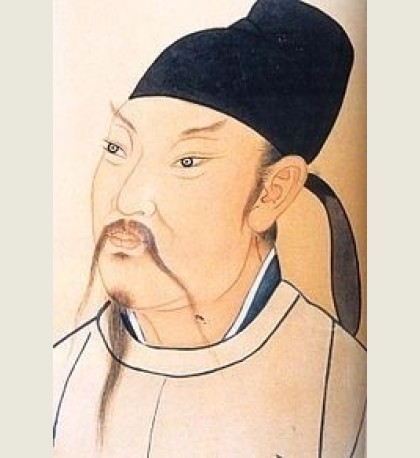
Li Bo was a Chinese poet of the Tang dynasty.
Known as the immortal genius of poetry (Chinese 詩仙, variant translations include “poet-saint” and “genius poet”), Li Bo is among the most revered poets in the history of Chinese literature. He left behind about 1,100 works, including about 900 poems. In the West, Li Bo became known through the works of Ezra Pound, the music of Gustav Mahler, and the translations of Hans Bethge. In Russian, his works have appeared in translations by N. Gumilev, A. Akhmatova, A. I. Gitovich, V. M. Alekseev, L. Z. Eidlina, L. E. Bezhin, and S. A. Toroptsev.
Li Bo is known for his unbridled imagination, provocative behavior, profound philosophical outlook, and vivid images of Daoists in his poetry, as well as, according to common legend, his love of alcohol. Like Du Fu, he spent much of his time traveling.
Li Bo was born into the family of a wealthy merchant. There are quite a few different versions as to the region in which the poet was born. Today, a significant number of researchers suggest that Li Bo may have originated from the area of former Turkestan (the Turkic Khaganate). Later, when he was 5 years old, his family moved to Qinglianxiang (modern Jiangyou in Sichuan Province). The poet’s ancestors belonged to the ruling family. Shortly before Li Bo was born, his mother dreamed of a large white star. For this reason, the boy was named Tai Bai (“great whiteness”). According to another legend, Li Bo was born from the star Tai Bai. For many, he embodied the spirit of the star, banished to the mortal world for a transgression.
Li Bo was educated at home. As he later recalled, his studies began at the age of five. Arithmetic came first, followed by acquaintance with the works of philosophers and writers, and with Chinese history and literature. At the age of seventeen, Li Bo went to the hermit Dong Yanzi, who lived in the mountains for several years. After that he traveled widely, read, and began writing poetry. The turmoil of the impulsive, romantic Li Bo’s
Books
Didn't find the book you were looking for?
