Maxim Gorky
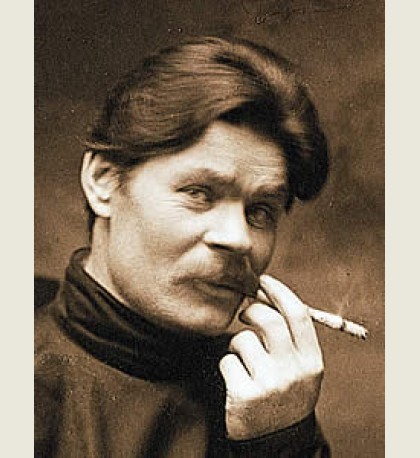
Maxim Gorky (real name - Aleksei Maksimovich Peshkov) was a prose writer, playwright, poet, and publicist. He was born in Nizhny Novgorod into the family of a cabinetmaker, and after his father's death lived in the family of his grandfather, V. Kashirin, the owner of a dyeing workshop.
At the age of eleven, having become an orphan, he began working, changing many "masters": as a messenger in a shoe store, a scullion on steamships, a draftsman, and others. Only reading books saved him from the despair of a bleak life.
In 1884 he came to Kazan to fulfill his dream of studying at the university, but very soon realized the utter impossibility of such a plan. He began to work. Later Gorky would write: "I did not expect help from outside and did not hope for a lucky chance... I understood very early that a person is shaped by his resistance to the surrounding environment." At the age of 16 he already knew much about life, but the four years spent in Kazan formed his personality and determined his path. He began propaganda work among workers and peasants (with the populist M. Romasem in the village of Krasnovidovo). From 1888 Gorky's wanderings across Russia began, with the aim of getting to know it better and becoming more closely acquainted with the life of the people.
He traveled through the Don steppes, across Ukraine, to the Danube, and from there - through Crimea and the Northern Caucasus - to Tiflis, where he spent a year working as a blacksmith's striker, then as a clerk in railway workshops, associating with revolutionary figures and taking part in illegal circles. At this time he wrote his first story, "Makar Chudra," published in a Tiflis newspaper, and the poem "The Girl and Death" (printed in 1917).
From 1892, after returning to Nizhny Novgorod, he engaged in literary work, publishing in Volga newspapers. From 1895 Gorky's stories appeared in metropolitan journals; in the "Samara Gazette" he became known as a feuilletonist, writing under the pseudonym Yehudi
Books
Didn't find the book you were looking for?
