Mark Twain
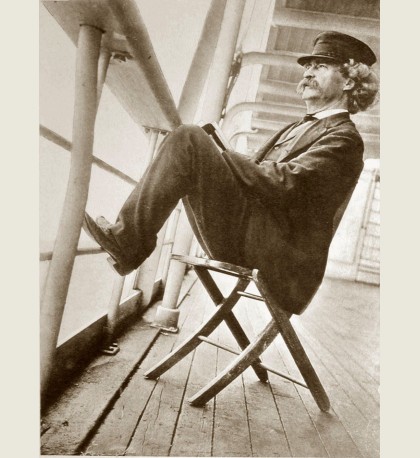
Mark Twain was an outstanding American writer, journalist, and public figure. His work spans many genres—realism, romanticism, humor, satire, philosophical fiction, journalism, and others—and in all of them he consistently maintained a humanist and democratic position.
Samuel Langhorne Clemens was born on November 30, 1835, in the small town of Florida, Missouri, USA; he later joked that by being born there he had increased its population by one percent. He was the third of four surviving children of John and Jane Clemens. When Sam was still a child, the family moved in search of a better life to the town of Hannibal, Missouri. It was this town and its inhabitants that Mark Twain later described in his famous works, especially in The Adventures of Tom Sawyer.
Clemens’s father died of pneumonia in 1847, leaving many debts. His eldest son, Orion, soon started publishing a newspaper, and Sam began to contribute to it to the best of his ability as a typesetter and, at times, as an article writer. Some of the newspaper’s liveliest and most controversial pieces actually came from the pen of the younger brother—usually when Orion was away. Sam himself also occasionally traveled to St. Louis and New York.
But the call of the Mississippi River ultimately drew Clemens to a career as a steamboat pilot. According to Clemens himself, it was a profession he would have pursued all his life if the Civil War had not ended private steamboat traffic in 1861. Thus Clemens was forced to look for other work.
After a brief stint with the militia, Clemens left the war for the West in July 1861. At that time his brother Orion was offered the post of secretary to the governor of Nevada Territory. Sam and Orion spent two weeks traveling across the prairies by stagecoach to the mining town of Virginia City, where silver was being mined in Nevada.
The experience of living in the American West shaped Twain as a writer and became the basis of his second book. In Nevada, hoping to strike it rich, Sam Clemens became a miner and began prospecting for silver. He had to live for long periods in camp with other prospectors—this way of life he later described in his writing. But Clem
Books


Didn't find the book you were looking for?
