Nellie Bly
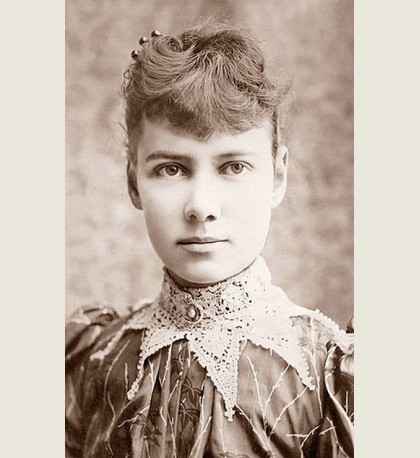
Nellie Bly (real name Elizabeth Jane Cochran) was an American journalist, writer, and businesswoman.
In 1880, the family moved to Pittsburgh, and in 1885 Bly began her career as a reporter for the Pittsburgh Dispatch. The newspaper published an article discriminatory toward women, and in response Cochran sent an angry letter to the editor, who was so impressed by it that he offered her a job. At that time, women journalists often published under pen names; Cochran chose the pseudonym Nellie Bly, after a popular song by Stephen Foster.
At first, Bly published notes in the newspaper about the plight of women working in Pittsburgh factories, life in the slums, and similar topics, but the editorial staff forced her to do what was then considered the extent of women’s contribution to journalism: write about society life, fashion, gardening, and the like. Opposed to this, in 1886–1887 Bly undertook a trip to Mexico, sending reports on the lives of Mexicans and describing corruption and the harsh conditions endured by the poor in Mexico. In one article, Bly spoke out against the arrest of a local journalist for criticizing the Mexican government (at the time Porfirio Díaz was in power), for which she was expelled from the country under threat of arrest. Her articles were later collected in the book Six Months in Mexico (1888).
Exposure of the Mental Hospital In 1887, Bly left the Pittsburgh Dispatch and moved to New York, taking a job at Joseph Pulitzer’s New York World. One of her first stunts was to feign insanity in order to enter the women’s insane asylum on Blackwell’s Island (now Roosevelt Island) and investigate the mistreatment of the clinic’s patients.
By simulating mental illness and amnesia and deceiving several doctors, Bly succeeded and spent ten days in the institution, later producing an exposé about the appalling conditions in which the asylum’s female patients lived, the abuse by the staff, and the fact that some of the patients had clearly been sent there by mistake. The article became a sensation and led not only the public but also the authorities to take interest in conditions in such institutions, significantly increasing the budget of the Department of Public Charities and Corrections.
Round-the-World Journey
Books

Didn't find the book you were looking for?
