Niccolò Machiavelli
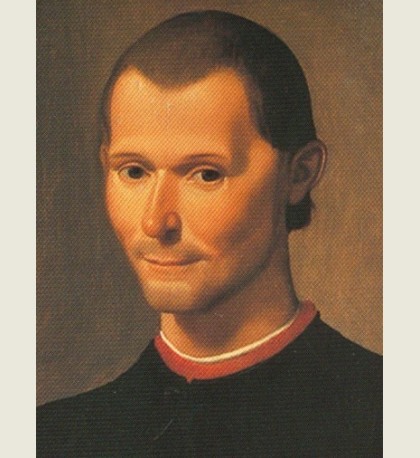
Niccolò Machiavelli — Italian thinker, philosopher, writer, and political figure.
“As an artist, when he paints a landscape, must descend into the valley in order to take in the hills and mountains with his gaze, and must climb the mountain in order to take in the valley, so here too: to grasp the essence of the people, one must be a prince, and to grasp the nature of princes, one must belong to the people.” These words practically conclude the short introduction preceding the treatise The Prince, which Niccolò Machiavelli presented as a gift to Lorenzo II de’ Medici, ruler of Florence. Almost 500 years have passed since then, yet they have not been enough to erase from people’s memory the name of the man who wrote a handbook for monarchs of all times and peoples.
He was immensely ambitious, pragmatic, and cynical. That is common knowledge. But how many know that this “villain,” who claimed that “the end justifies the means,” was an honest, hardworking man endowed with remarkable intuition and an ability to enjoy life? Probably this fact too could seem quite obvious, if acquaintance with Machiavelli’s personality did not end with reading and quoting individual fragments from his scandalously famous The Prince. It is a pity, because this man deserves far more attention; he is interesting already because he was born in Florence during the Renaissance.
Niccolò Machiavelli was born on May 3, 1469, in the village of San Casciano, near the city-state of Florence, now in Italy, and was the second son of Bernardo di Niccolò Machiavelli (1426–1500), a lawyer, and Bartolomea di Stefano Nelli (1441–1496). His education gave him a thorough knowledge of the Latin and Italian classics.
Machiavelli lived in a turbulent era, when the Pope could command an entire army and the wealthy city-states of Italy fell one after another under the rule of foreign powers — France, Spain, and the Holy Roman Empire. It was a time of constant shifts in alliances, of mercenaries who would switch sides without warning, when power that had lasted only a few weeks would collapse and be replaced by a new one. Perhaps the most significant event in this series of chaotic upheavals was the
Books

Didn't find the book you were looking for?
