Honoré de Balzac
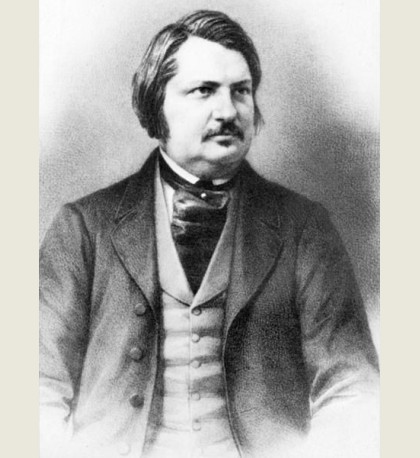
Honoré de Balzac was a French novelist, born on May 20, 1799, in Tours; his family, originally peasants, came from southern France (Languedoc). His father changed the original surname Balssa after coming to Paris in 1767 and beginning a long civil-service career there, which he continued in Tours from 1798, holding a number of administrative posts. The particle “de” was added to the name by his son Honoré in 1830, in an effort to claim noble origin. Balzac spent six years (1806–1813) as a boarder at the College of Vendôme, completing his education in Tours and Paris, where the family returned in 1814. After working for three years (1816–1819) as a clerk in a legal office, he persuaded his parents to allow him to try his luck in literature. Between 1819 and 1824 Honoré published (under a pseudonym) about half a dozen novels written under the influence of J.-J. Rousseau, W. Scott, and “horror novels.” In collaboration with various literary hacks he produced numerous novels of an overtly commercial kind.
In 1822 his association began with the forty-five-year-old Madame de Berny (d. 1836). The passion, intense at first, enriched him emotionally; later their relationship became platonic, and Le Lys dans la vallée (1835–1836) presented an extremely idealized picture of this friendship.
An attempt to make a fortune in publishing and printing (1826–1828) left Balzac deeply in debt. Returning to writing, he published the novel Les Chouans in 1829 (Le dernier Shouan; revised and issued in 1834 under the title Les Chouans). This was the first book to appear under his own name; together with the humorous manual for husbands La Physiologie du mariage (1829), it drew public attention to the new author. The main work of his life began at the same time: in 1830 the first Scènes de la vie privée appear, with the indisputable masterpiece La Maison du chat-qui-pelote
Books



Didn't find the book you were looking for?
