Osip Mandelstam
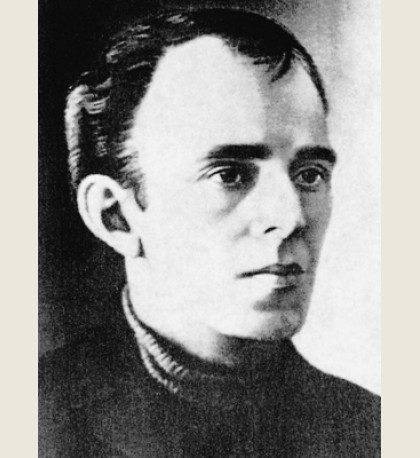
Mandelstam, Osip Emilievich — Russian poet, prose writer, translator, essayist.
He came from a St. Petersburg Jewish merchant family. He studied at the Tenishev School and was interested in the Socialist Revolutionary movement (memoir The Noise of Time, 1925). In 1907–08 he attended lectures in Paris, in 1909–10 in Heidelberg, and in 1911–17 studied Romance philology at St. Petersburg University (but did not complete the course).
Symbolism His first verse experiments in the populist style date from 1906; systematic work on poetry began in 1908, and his first publication appeared in 1910. Mandelstam drew close to Symbolism (he visited V. I. Ivanov and sent him his poems). His program was to combine “Tyutchev’s severity with Verlaine’s childishness,” loftiness with childlike immediacy. A recurring theme in his poems is the fragility of this world and of man in the face of incomprehensible eternity and fate (“Am I really real / And will death indeed come?..”); the intonation is one of astonished simplicity; the form consists of short poems with very concrete images (landscapes, verse still lifes). The poet sought a way out in religion (especially intensely in 1910), attended meetings of the Religious-Philosophical Society, but in his poetry his religious motifs are chastely restrained (“Relentless words...” about Christ, who is not named). In 1911 he was baptized according to the Methodist rite. Of the poems from these years, Mandelstam included less than a third in his books.
Acmeism In 1911 Mandelstam drew closer to N. S. Gumilev and A. A. Akhmatova; in 1913 his poems Notre Dame and “Hagia Sophia” were published in the programmatic Acmeist selection (see Acmeism). For him, the program of Acmeism meant concreteness, “this-worldliness,” “the complicity of beings in a conspiracy against emptiness and nonbeing,” overcoming human frailty and the inertia of the universe through creativity (“Out of bad heaviness I shall one day
Books

Didn't find the book you were looking for?
