Prokudin-Gorskiy Sergey
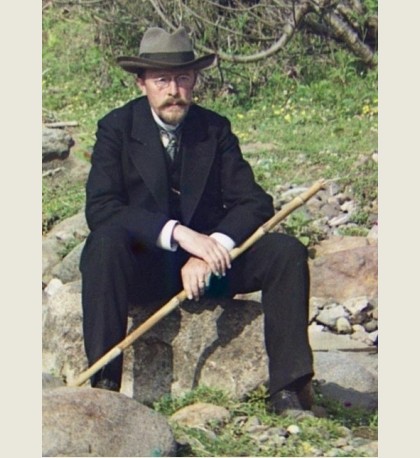
His father, Mikhail Nikolayevich, after serving in the Caucasus (in the Tiflis Grenadier Regiment), retired in 1862 with the rank of second lieutenant and married. Sergey Mikhailovich Prokudin-Gorsky was born on 18/30 August 1863 in the ancestral estate of the Prokudin-Gorskys, Funikova Gora, in Pokrovsky Uyezd of Vladimir Governorate. On 20 August (1 September) 1863 he was baptized in the Church of Archangel Michael at the nearby Archangel cemetery church, in whose cemetery in 2008 a gravestone was discovered bearing the name of his full namesake, Sergey Mikhailovich Prokudin-Gorsky (1789–1841). For three years, until 1886, he studied at the Alexander Lyceum, but did not complete the full course. From October 1886 to November 1888 he attended lectures in the natural sciences section of the Faculty of Physics and Mathematics at Saint Petersburg University. From September 1888 to May 1890 he was a student at the Imperial Military Medical Academy, which he did not graduate from. He studied painting at the Imperial Academy of Arts. In May 1890 he entered the service of the Demidov Home for the Care of Workers as a full member. This social institution for girls from poor families was founded in 1830 with funds from the well-known patron Anatoly Demidov and was under the jurisdiction of the Department of Institutions of Empress Maria Feodorovna. In 1890 he married Anna Alexandrovna Lavrova (1870–1937), daughter of the Russian metallographer and director of the partnership of the Gatchina bell, copper-smelting, and steel plants, Lavrov. Prokudin-Gorsky himself became director of the board at his father-in-law’s enterprise. In 1897 Prokudin-Gorsky began delivering reports on the technical results of his photographic research to the Fifth Department of the Imperial Russian Technical Society (IRTO) (he continued these reports until 1918). In 1898 Prokudin-Gorsky became a member of the Fifth Photographic Department of the IRTO and gave a presentation, “On Photographing Falling Stars (Meteor Showers).” By that time he was already a Russian authority in the field of photography, and was entrusted
Books

Didn't find the book you were looking for?
