Rudyard Kipling
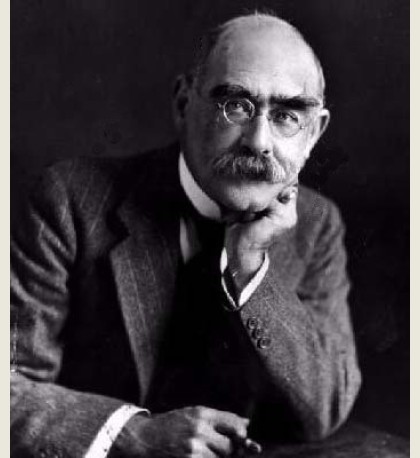
Joseph Rudyard Kipling was an English writer, poet, and short-story writer.
Rudyard Kipling was born in Bombay (India) into the family of John Lockwood Kipling, a professor at the local School of Art, and Alice (MacDonald) Kipling. He is believed to have been given the name Rudyard in honor of the English lake Rudyard, where his parents first met. His early years, full of the exotic sights and sounds of India, were very happy ones for the future writer. But at the age of 5 he was sent with his sister to England to study. For 6 years he lived in a private boarding house, whose owner, Madame Rosa, treated him badly and punished him. This treatment affected him so strongly that he suffered from insomnia for the rest of his life.
At the age of 12, his parents placed him in the private Devon School so that he could later enter a prestigious military academy. The headmaster of the school was Cormell Price, Rudyard’s father’s friend. It was he who encouraged the boy’s love of literature. Poor eyesight prevented Kipling from choosing a military career, and the school did not provide the diplomas needed to enter other universities. Impressed by the stories written at school, his father found him a job as a journalist in the editorial office of the Civil and Military Gazette, published in Lahore (British India, now Pakistan).
In October 1882 Kipling returned to India and took up work as a journalist. In his spare time he wrote short stories and poems, which were then published by the newspaper along with reports. Work as a reporter helped him better understand the various aspects of colonial life in the country. The first sales of his works began in 1883.
The era of travel
In the mid-1880s Kipling began traveling through Asia and the United States as a correspondent for the Allahabad newspaper Pioneer, with which he had signed a contract to write travel sketches. The popularity of his works grew rapidly; in 1888 and 1889 six books of his stories were published, bringing him recognition.
In 1889 he made a long journey to England, then visited Burma, China, and Japan. He traveled across the United States, crossed the Atlantic
Books


Didn't find the book you were looking for?
