Rot Yozef
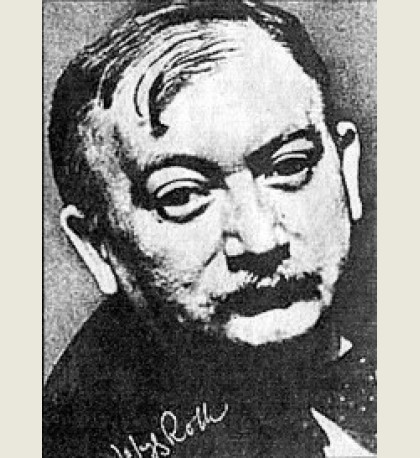
Moses Joseph Roth was an outstanding Austrian writer, a classic of twentieth-century world literature, the author of famous novels, a brilliant and holy drunkard—the singer of Habsburg idyll with its multicultural variegation and tolerance.
Joseph Roth was born in Galicia, in the town of Brody (now the administrative center of Lviv Oblast, Ukraine) on September 2, 1894. The population of Brody, which belonged to the Austro-Hungarian Empire, was three-quarters Jewish and one-quarter Ukrainian, Polish, and German. Roth did not know his father: shortly after the marriage the latter went mad and was placed in an institution. His mother protected her only son from the shameful misfortune. Barely literate, she spared no effort in raising and educating the boy. Thanks to his mother, Moses Joseph studied not in a communal Jewish school, but in a city school. Instruction was conducted mainly in German, mastery of which offered hope for future success. In addition, Roth studied Polish (without much diligence) and Hebrew. He then entered the Crown Prince Rudolf Gymnasium, where he became fascinated by literature and the poetry of Heinrich Heine. In 1913 Roth became a student at Lviv University.
Dependence on his wealthy maternal uncle, in whose house he lived, oppressed him. The next year Joseph Roth moved to the capital and entered the University of Vienna. The literary talent of the young philologist specializing in German studies emerged during the First World War. He wrote and published in the periodical press of the Austrian capital the stories “The Model Student” (1916) and “Barbara” (1918), as well as numerous poems.
In 1916 the student Roth unexpectedly interrupted his studies and enlisted as a volunteer in the army. This astonishing decision was explained in every possible way: by patriotism suddenly awakened, and by curiosity! As a twenty-year-old recruit, the future creator of Radetzky March stood in the cordon at the funeral of Emperor Franz Joseph and wept, realizing that in the Capuchin Crypt they were burying not merely an old man who had outlived his time, but an era.
The unit in which Roth served was located in the swamps of Galicia, not far from the writer’s
Books

Didn't find the book you were looking for?
