Stefan Tsveyg
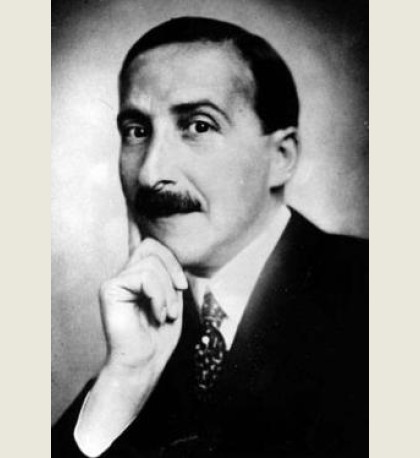
Stefan Zweig was an Austrian writer, critic, and author of numerous novellas and fictionalized biographies.
Zweig was born in Vienna into the family of a wealthy Jewish merchant who owned a textile manufactory. In the memoir The World of Yesterday, Zweig speaks with deliberate restraint about his childhood and adolescence. When he turns to the parental home, the gymnasium, and then the university, the writer consciously does not give free rein to emotion, emphasizing that at the beginning of his life everything was exactly the same as for other European intellectuals at the turn of the century.
After graduating from the University of Vienna, Zweig traveled to London and Paris (1905), toured Italy and Spain (1906), and visited India, Indochina, the United States, Cuba, and Panama (1912). In the last years of the First World War Zweig lived in Switzerland (1917-1918), and after the war he settled near Salzburg.
While traveling, Zweig satisfied his curiosity with rare zeal and persistence. His sense of his own giftedness prompted him to write poetry, and his parents’ substantial fortune allowed him to publish his first book without difficulty. Thus appeared Silver Strings (Silberne Seiten, 1901), published at the author’s own expense. Zweig dared to send his first book of poems to his idol, the great Austrian poet Rainer Maria Rilke. Rilke sent back one of his own books. Thus began a friendship that lasted until Rilke’s death. Zweig was friendly with such outstanding cultural figures as E. Verhaeren, R. Rolland, F. Masereel, O. Rodin, T. Mann, S. Freud, J. Joyce, G. Hesse, H. G. Wells, and P. Valéry.
During the First World War Zweig published a heartfelt essay on R. Rolland, calling him the “conscience of Europe.” Zweig dedicated essays to Maxim Gorky, Thomas Mann, Marcel Proust, and Joseph Roth.
Zweig came to love Russian literature already in his gymnasium years, and later read the Russian classics attentively while studying at the Universities of Vienna and Berlin. When a collected edition of Zweig’s works began to appear in
Books


Didn't find the book you were looking for?
