Stig Larsson
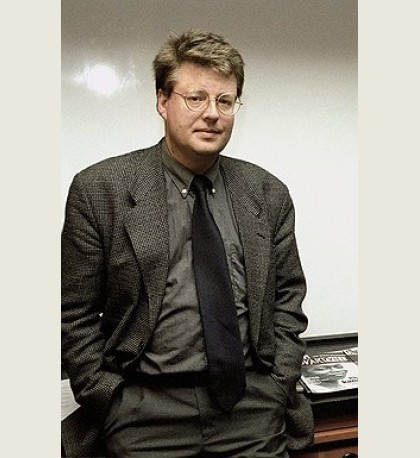
For practically his entire life, Stieg Larsson worked for the tiny Stockholm left-wing newspaper Fjärde internationalen (“The Fourth International”), where he first served as a graphic designer and later as a journalist. He took the problem of Swedish neo-Nazism very seriously and even gave lectures on the subject for Scotland Yard. In 1995, he founded the Expo Foundation to combat youth extremism, and from 1999 he was the editor-in-chief of the anti-fascist magazine of the same name published by the foundation. He was chairman of the Swedish science fiction fan club Skandinavisk Förening för Science Fiction (SFSF).
The Millennium trilogy is called one of the major publishing sensations of recent years. The first book, Män som hatar kvinnor (“Men Who Hate Women”), was published in 2005, Flickan som lekte med elden (“The Girl Who Played with Fire”) in 2006, and Luftslottet som sprängdes (“The Air Castle That Exploded”) in 2007.
Stieg Larsson signed a contract to publish three novels about Mikael Blomkvist, but did not live to see them in print. In 2004, he died of a massive heart attack at the age of 50. At present, the novels, which enjoy extraordinary popularity, have been translated into dozens of languages and published in a total circulation of more than 21 million copies.
Millennium, Larsson’s debut in fiction, was supposed to become a ten-volume series. But of the ten books, Larsson managed to write only three and a half, sold the rights to the largest Swedish publishing house, and died before the first volume came out. Fame came to him posthumously, and the debate over whether to publish the unfinished fourth volume and to release the outlines for two more books is more heated than any discussion of Nabokov’s Laura.
In the memories of those who knew Larsson, he himself appears somewhat like a literary character. In his large 1980s-style glasses and worn corduroy jacket, he smoked constantly and consumed gargantuan amounts of black coffee. He never appeared in the office before noon, but once he arrived, he worked until three or four in the morning. And after returning home, he would write for another hour or two before going to bed.
<Books

Didn't find the book you were looking for?
