Stephen Hawking
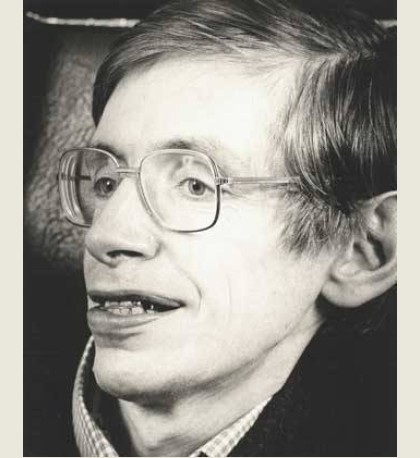
STEPHEN WILLIAM HAWKING is an English theoretical physicist. He studied at Oxford and then at Cambridge, where he became professor of mathematics. He studied the theory of the origin of the universe as a result of the Big Bang, as well as the theory of black holes. He proposed the hypothesis that small black holes lose energy by emitting Hawking radiation and, eventually, “evaporate.” A popularizer of science, Hawking is one of the most scientifically influential and widely known theoretical physicists of our time.
In 1962, he graduated from the University of Oxford and began studying theoretical physics. Around the same time, Hawking began to show symptoms of amyotrophic lateral sclerosis, which led to paralysis. In 1965, he married Jane Wilde; later they had a daughter and two sons. In 1974, Hawking became a fellow of the Royal Society of London. After throat surgery in 1985, he lost the ability to speak. Friends gave him a speech synthesizer, which was mounted on his wheelchair and through which Hawking could communicate with people.
He currently holds the Lucasian Professorship of Mathematics at the University of Cambridge, a position once held by Isaac Newton three centuries ago. Despite his severe illness, he leads an active life. In January 2007, he took a zero-gravity flight (on a special aircraft), and a spaceflight was planned for 2009. In addition, Hawking has appeared several times in the animated series The Simpsons and Futurama, where he voiced himself.
Hawking’s main fields of research are cosmology and quantum gravity. His principal achievements are: - the application of thermodynamics to the description of black holes. - the development of the theory that black holes “evaporate” due to the phenomenon known as Hawking radiation. - on July 21, 2004, Hawking presented a paper in which he set out his view on resolving the paradox of the disappearance of information in a black hole.
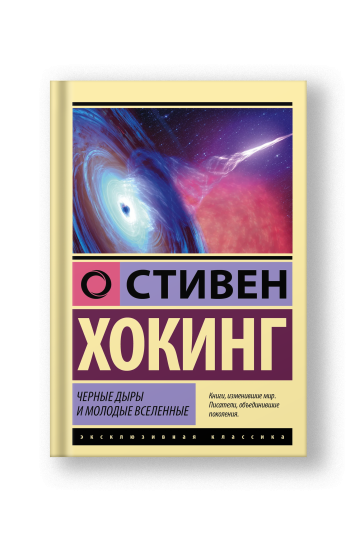
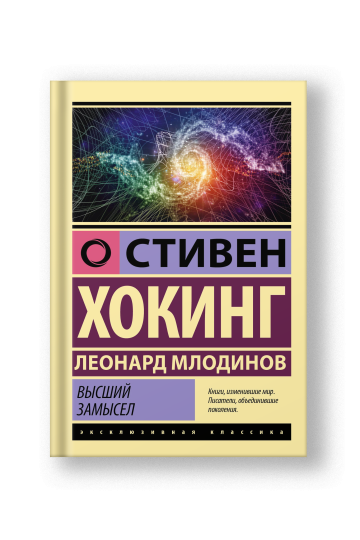
Hawking is actively involved in popularizing science. In April 1988, the book A Brief History of Time was published and became a bestseller. Thanks to this book, Hawking became world-famous. In the preface, he wrote:
I was told that every formula included in
Books



Didn't find the book you were looking for?
