Syue-tsin Tsao
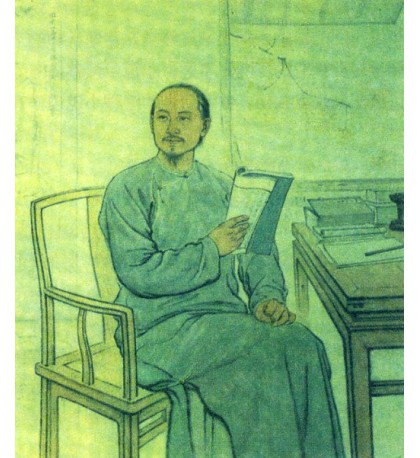
Cao Xueqin (real name Cao Zhan) was a Chinese writer. There is no exact information about his dates of life: some sources say that he was born in 1715, others in 1724; his year of death is considered to be either 1762 or 1764.
Although the Cao clan was Chinese, for services rendered to the Qing dynasty it was enrolled in the Plain White Banner of the Eight Banner Army. By the time Cao Xueqin was born, the family had already fallen into decline, and by the time he reached maturity he was living in poverty in a mountain village near Beijing. Witnessing the decay of feudal society, the writer observed with his own eyes the collapse of the way of life of noble families, and he himself also endured many hardships. In his youth Cao Xueqin lost his parents, in the prime of life he lost his wife, and in old age he lost his children.
Cao Xueqin was a many-sided talent. He drew well, was a skilled calligrapher, knew a great deal about crafts and even medicine, and also composed excellent poetry. He entered history with his novel Dream of the Red Chamber. When Cao Xueqin was creating his work, it was enough for him to write just a few chapters for someone to borrow them to read, after which the manuscript began to circulate in copies; as a result, a huge number of handwritten copies of the novel have survived to our time.
As soon as it appeared, the novel shocked readers from different strata of Chinese society. Some copied it out, others cursed it, some even burned the manuscripts, while others praised it to the skies; but no one remained indifferent, and everyone talked about the novel — both common people and high officials. Beginning in the 1760s, new printed editions of the novel were published one after another.
Books
Didn't find the book you were looking for?
