William Somerset Maugham
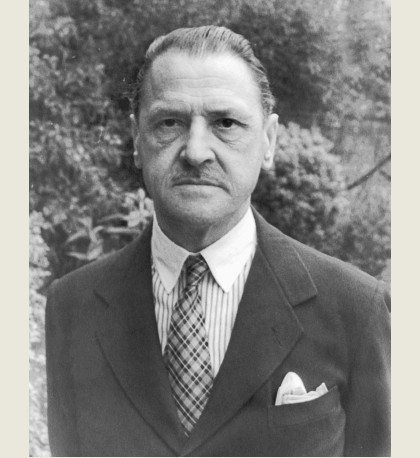
William Somerset Maugham was an English writer, one of the most successful prose writers of the 1930s, and an agent of British intelligence.
Somerset Maugham was born into the family of a lawyer at the British embassy in France. His parents deliberately arranged for the birth to take place on embassy grounds so that the child would have legal grounds to say he had been born on British territory: it was expected that a law would be passed under which all children born on French territory would automatically become French citizens and, upon reaching adulthood, would thus be liable for military service in the event of war.
As a child, Maugham spoke only French; he learned English only after being orphaned at the age of 11 (his mother died of tuberculosis in February 1882, his father died of stomach cancer in June 1884) and was sent to relatives in the English town of Whitstable in Kent, six miles from Canterbury. Upon arriving in England, Maugham began to stammer, and this remained with him for life.
Since William was raised in the family of Henry Maugham, the vicar of Whitstable, he began his studies at The King’s School, Canterbury. He then studied literature and philosophy at Heidelberg University. In Heidelberg, Maugham wrote his first work, a biography of the German composer Meyerbeer (when it was rejected by the publisher, Maugham burned the manuscript).
He then entered medical school in 1892 at St Thomas’ Hospital in London; this experience is reflected in Maugham’s first novel, Liza of Lambeth (1897). Maugham’s first success in literature came with the play Lady Frederick (1907).
During the First World War, he cooperated with MI5 and was sent to Russia as an agent of British intelligence. His work as a spy is reflected in the collection of novellas Ashenden, or The British Agent (1928; Russian translation 1992). In May 1917, Maugham married Syrie Wellcome.
After the war, Maugham continued his successful career as a playwright, writing the plays The Circle (1921) and Sheppe
Books



Didn't find the book you were looking for?
