Veniamin Kaverin
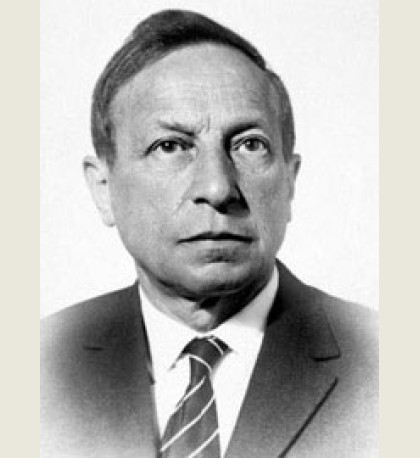
Veniamin Aleksandrovich Kaverin was a Russian and Soviet writer and screenwriter.
His real surname was Zilber; his literary pseudonym was adopted in honor of Pyotr Pavlovich Kaverin, a hussar, a duelist-brawler, and a riotous reveler, in whose escapades the young Pushkin often took part.
Veniamin Kaverin was born on April 6 (19), 1902, in Pskov, into the family of the bandmaster of the 96th Infantry Omsk Regiment; of his six children, Veniamin was the youngest. From childhood, he was greatly influenced by his elder brother Lev, who later became a world-famous scientist, microbiologist and immunologist, an academician, and one of the creators of the viral theory of cancer. In 1912, Kaverin entered the Pskov Gymnasium, where he studied for six years. In 1919, he moved to Moscow, completed secondary school there, and entered the history and philology faculty of the university. He was fond of writing poetry, but after severe criticism from O. E. Mandelstam and V. B. Shklovsky he abandoned his versification experiments. At the same time, he worked in a student cafeteria, then in the library of the Moscow Military District and in the art subdivision of the Moscow Soviet.
In 1920, on the advice of Yury Tynyanov (the husband of Kaverin’s sister), whom he considered his literary teacher, he moved to Petrograd, where he continued his education at the philosophy faculty of the university, while also studying in the Arabic department of the Institute of Living Oriental Languages. As a philologist, he was drawn to little-studied pages of Russian literature of the early 19th century: the works of V. F. Odoevsky, A. F. Velman, and O. I. Senkovsky. In 1923, he graduated from the Institute of Oriental Languages, and in 1924 from the university, where he remained for postgraduate study. At the same time, Kaverin taught at the Institute of the History of the Arts. In 1929, Kaverin defended his candidate dissertation in Russian philology, entitled “Baron Br
Books

Didn't find the book you were looking for?
