Vladimir Dal
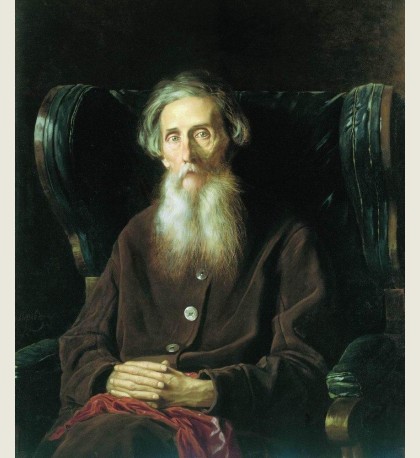
Vladimir Ivanovich Dal (10 (22) November 1801 — 22 September (4 October) 1872) was a Russian writer, ethnographer, linguist, lexicographer, and physician. He became famous as the author of Explanatory Dictionary of the Living Great Russian Language. Pseudonym: Kazak Lugansky. Dal’s father was of Danish origin and was educated in Germany, where he studied theology and ancient and modern languages. His mother, a German, knew five languages. Dal received his education at home and wrote poetry. In 1815 he entered the Naval Cadet Corps in St. Petersburg. He later described his studies there, in the story Midshipman Potseluev, or Keep Looking Back While You Live (1841), as “years killed.” A training voyage to Denmark convinced him that “my fatherland is Russia, that I have nothing in common with the fatherland of my ancestors.” Upon completing his studies in 1819, he was assigned to serve as a midshipman in the Black Sea Fleet. At that time Dal, as he put it, began “unconsciously” to record words unfamiliar to him, thus embarking on the chief work of his life: the creation of the Explanatory Dictionary of the Living Great Russian Language.
During his service Dal continued writing poetry, which brought him trouble: for an epigram on the commander-in-chief of the Black Sea Fleet in 1823, he was placed under arrest. Acquitted by the court, Dal was transferred to Kronstadt, and in 1826 he retired and entered the medical faculty of Derpt University. His financial situation was difficult; he earned his living by tutoring, yet the years of study remained among the brightest memories of his life. Dal wrote poetry and one-act comedies, became acquainted with the poets Yazykov and Zhukovsky, the surgeon Pirogov, and the editor of the journal Slavyanin, Voyeykov, who first published Dal’s poetry in 1827.
In 1829 Dal successfully defended his dissertation and was sent to the Russo-Turkish War as part of the active army. Working in a field hospital, he became an outstanding surgeon. Dal continued gathering material for the future Dictionary, recording from soldiers the “regional expressions” of various localities. It was then that the impressions of his childhood were confirmed
Books
Didn't find the book you were looking for?
