Volodimir Vinnichenko
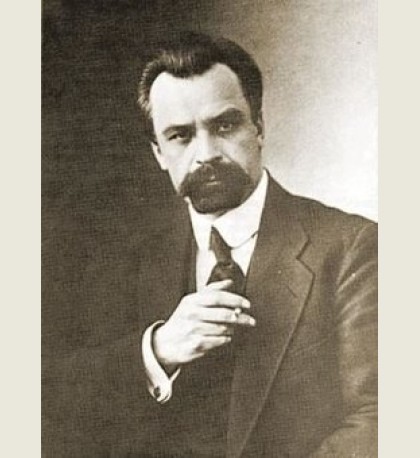
Born on 28 July 1880 into a peasant family. His father, Kyrylo Vasylovych Vinnychenko, a peasant farm laborer, moved from the village to Yelysavethrad (now Kirovohrad) and married the widow Yevdokiia Pavlenko, née Linnyk. From her first marriage, Vinnychenko’s mother had three children: Andrii, Mariia, and Vasyl; from her marriage to Kyrylo Vinnychenko, one child was born, Volodymyr. At primary school, Volodymyr proved to be a capable pupil, and his parents, despite the family’s difficult financial situation, decided to continue his education.
From the age of ten he received secondary education at the Yelysavethrad Gymnasium. He was given scant financial assistance for his studies by his elder brother, who worked in the city printing house. However, already in the seventh grade Volodymyr Vinnychenko was expelled from the gymnasium after spending a week in the punishment cell for writing a revolutionary poem. Lacking means of support, he was forced to wander through Southern Ukraine in search of temporary work, while intensively pursuing self-education. Then, in 1900, he passed the examinations as an external candidate at the Zlatopil Gymnasium and received a secondary-school leaving certificate.
In 1901 he entered the law faculty of Saint Volodymyr Kyiv University. By that time he had already become acquainted with socialist doctrine through popular expositions of Karl Marx’s works distributed illegally, and had strengthened his social-democratic convictions. Immediately after enrolling at Kyiv University, he created there a secret revolutionary student organization called the “Student Community,” and later took an active part in the revolutionary movement.
He belonged to the Kyiv Hromada and early joined the Revolutionary Ukrainian Party—the first political party in the Ukrainian part of the Russian Empire. At the party’s direction he carried out agitation and propaganda work among Kyiv workers and the peasants of Poltava Province; for this he was arrested in 1902 and, before finishing his first year, expelled from the university without the right to continue his studies at any other higher educational institution. Leaving for Poltava region, he began working as a private tutor and managed to take part in the work of the First Congress of the
Books
Didn't find the book you were looking for?
