Jean-Paul Sartre
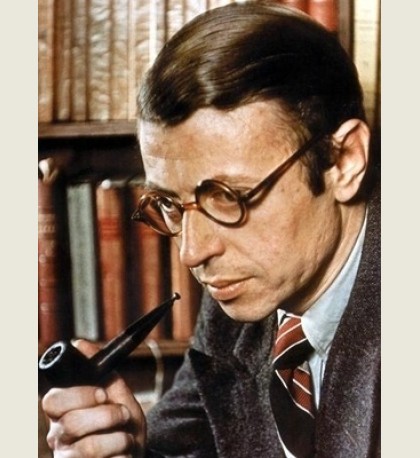
JEAN-PAUL CHARLES AYMARD SARTRE — French philosopher, representative of atheistic existentialism, writer, playwright, essayist, and teacher. Nobel Prize in Literature laureate in 1964 (he declined the prize).
Jean-Paul Sartre was born in Paris and was the only child in the family. When Jean-Paul was just 15 months old, his father died. The family moved to his grandparents’ house in Meudon.
Sartre was educated at the lycées of La Rochelle, graduated from the École Normale Supérieure in Paris with a dissertation in philosophy, and trained at the French Institute in Berlin (1934). He taught philosophy at various lycées in France (1929-1939 and 1941-1944); from 1944 he devoted himself entirely to literary work. While still a student, he met Simone de Beauvoir, who became not only his life partner but also a like-minded author.
Together with Simone de Beauvoir and Maurice Merleau-Ponty, he founded the journal Les Temps Modernes. He выступed as a supporter of peace at the Vienna Congress of Peoples in Defense of Peace in 1952; in 1953 he was elected a member of the World Peace Council. After repeated threats from French nationalists, they bombed his apartment in central Paris.
In 1956, Sartre and the journal’s editorial board, unlike Camus, distanced themselves from the idea of French Algeria and supported the Algerian people’s aspiration for independence. Sartre opposed torture, affirming the freedom of peoples to determine their own destiny.
Defending his position was not done in safety: Sartre’s apartment was blown up twice, and the editorial office was seized five times by nationalist militants.
Sartre actively supported the Cuban Revolution of 1959, like many representatives of the intelligentsia in Third World countries. In June 1960 he wrote 16 articles in France entitled “The Sugar Hurricane.” At that time he collaborated with the Cuban news agency Prensa Latina. But later there was a break with Castro in 1971 because of the “Padilla affair,” when the Cuban poet Padilla was imprisoned for criticizing the Castro regime.
Sartre took an active part in the
Books
Didn't find the book you were looking for?
