Daniil Kharms
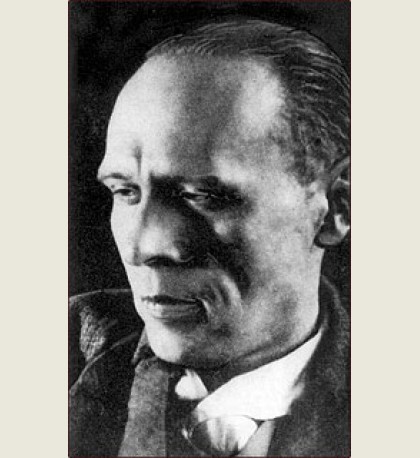
Daniil Ivanovich Kharms (real surname Yuvachev) was a Russian and Soviet writer and poet. He was a member of the OBERIU association.
Daniil Yuvachev was born on 17 (30) December 1905 in Saint Petersburg, into the family of Ivan Yuvachev, a former naval officer, a Narodnaya Volya revolutionary exiled to Sakhalin, where he turned to religious philosophy. Kharms’s father knew Chekhov, Tolstoy, and Voloshin.
Daniil studied at the privileged German school Petrishule in Saint Petersburg. In 1924 he entered the Leningrad Electrotechnical College, but soon had to leave it. In 1925 he began writing. In his early youth he imitated the futurist poetics of Khlebnikov and Kruchenykh. Later, in the second half of the 1920s, he abandoned the dominance of zaum in verse.
In 1925 Yuvachev became acquainted with the poetic and philosophical circle of the chinari, which included Alexander Vvedensky, Leonid Lipavsky, Yakov Druskin, and others. He quickly gained scandalous fame in avant-garde literary circles under the pseudonym “Kharms,” which he had invented at the age of 17. Yuvachev had many pseudonyms and changed them playfully: Khharms, Khaarms, Dandan, Charms, Karl Ivanovich Shusterling, and others. However, it was the pseudonym “Kharms,” with its ambivalence (from the French charme — “charm, allure” and the English harm — “damage”), that most accurately reflected the essence of the writer’s attitude to life and creativity. The pseudonym was also entered in the registration questionnaire of the All-Russian Union of Poets, which accepted Kharms in March 1926 on the basis of the poems he had submitted, two of which (“A Case on the Railroad” and “Peter Yashkin’s Poem — a Communist”) were published in low-circulation Union collections. Apart from them, until the late 1980s only one “adult” work by Kharms was published in the USSR — the poem “Maria Comes Out, Bending in a
Books

Didn't find the book you were looking for?
