de la Mott Fuke Fridrikh
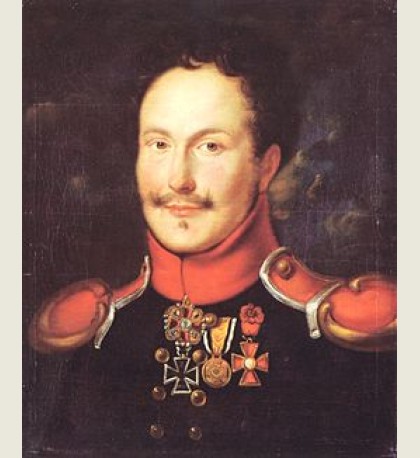
Friedrich Heinrich Karl de la Motte Fouqué was a German Romantic poet and writer, best known for the fairy-tale novella Undine (1811).
By origin he was a baron descended from French Huguenot émigrés who settled in Prussia. Fouqué’s grandfather was a general to whom Frederick the Great granted the knightly academy founded in 1703 on a small island near Brandenburg an der Havel.
From infancy the future writer was raised in an atmosphere of chivalry and martial valor, hence his natural wish to become a soldier. His father Karl was an officer in the Prussian army, and his mother Louise (née von Schlegel) came from an old noble family. She was the goddaughter of the Prussian king Frederick II. Louise sought to direct her son’s interests toward scholarship and education. For this purpose August Hülsen was invited into the home as a tutor. Under his guidance Friedrich began to study ancient Greek and the works of Homer, became acquainted with examples of German heroic epic (the Edda) and the great works of dramatic art (Shakespeare).
1792 — formation of the anti-French coalition. Fouqué is eager to go to war. 1794 — Fouqué became a cornet in the Duke of Weimar’s cuirassier regiment. 1795 — peace was concluded with France. Fouqué did not manage to take part in battles; he continued to feel interest in France and admired Napoleon. 1795–1799 — rapprochement between Fouqué and his teacher Hülsen. Fouqué’s favorite novel becomes Ludwig Tieck’s Franz Sternbald’s Wanderings.
In 1798 he married Marianne von Schubert. In 1802 their marriage broke up. While living in Weimar he became acquainted with Goethe, Schiller, and Herder. In 1803 his wife became Karoline von Rochow, better known as Karoline de la Motte Fouqué — a writer and hostess of a literary salon whose visitors included, among others, Adelbert von Chamisso, Joseph von Eichendorff, August Wilhelm Schlegel, and E. T. A. Hoffmann.
At this time he, together with his new
Books
Didn't find the book you were looking for?
