Ernst Yunger
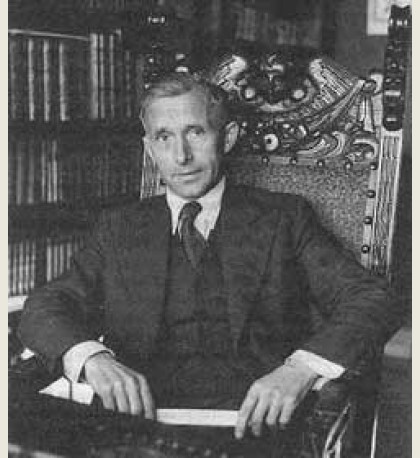
Ernst Jünger was a German writer and thinker, and one of the principal theorists of the Conservative Revolution.
He was born in Heidelberg, into the family of Dr. phil. Ernst Georg Jünger. His father, who held a doctorate in chemistry, left an academic career, and the family moved to Schwarzenberg (Saxony), where the elder Jünger became the owner of a pharmacy. From 1901 to 1913, Ernst Jünger attended a boarding school in Hanover. In 1913 he ran away from home in order to join the French Foreign Legion. His father used diplomatic channels to have him returned. Together with his brother Friedrich Georg Jünger, he took part in the Wandervogel movement. The group was known as the voice of discontented middle-class youth, and its hiking trips across Germany were a gesture of protest. On his return, Jünger reached an agreement with his father according to which he was to complete his education before taking part in an expedition to Kilimanjaro.
He served at the front from December 1914 to November 1918. In August 1914 he completed his examinations early, entered Heidelberg University, and enlisted in the 73rd Hanoverian Regiment. From December 1914 he took part in combat as a private soldier; after attending officers’ courses, he commanded a platoon and then a company. He took part in the battles of the Somme, Langemarck, and Cambrai, and in the spring offensive of 1918. He was wounded for the first time in combat near Gillemont. During the years of the First World War, Jünger was wounded 14 times, including three double wounds, among them: a through-and-through gunshot wound to the head (forehead to nape), a through-and-through gunshot wound to the left side of the sternum, a through-and-through wound to the right side of the sternum, loss of the phalanx of the little finger of the left hand, and loss of the phalanx of the index finger of the left hand (as a result of English grenades).
When one is bored lying down, one looks for all kinds of ways to pass the time; once I spent time counting my wounds. I established that, not counting trifles such as
Books

Didn't find the book you were looking for?
