Gomer
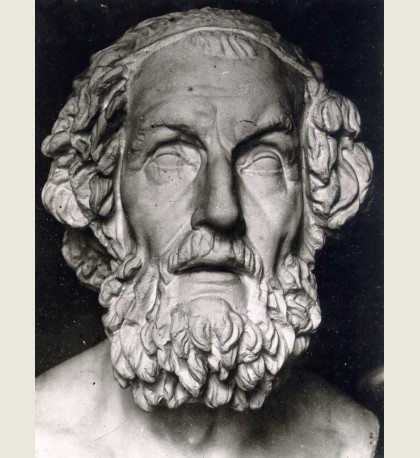
Homer was a legendary ancient Greek poet and bard, to whom the creation of the Iliad and the Odyssey is attributed.
Nothing reliable is known about Homer’s life or personality. It is clear, however, that the Iliad and the Odyssey were composed significantly later than the events they describe, but earlier than the 6th century BC, when their existence is securely attested. The chronological period in which modern scholarship places Homer’s life is approximately the 8th century BC.
Homer’s birthplace is unknown. Seven cities competed for the right to call themselves his homeland: Smyrna, Chios, Colophon, Salamis, Rhodes, Argos, and Athens. According to Herodotus and Pausanias, Homer died on the island of Ios in the Cyclades. It is likely that the Iliad and the Odyssey were composed on the Asia Minor coast of Greece, settled by Ionian tribes, or on one of the nearby islands. However, the Homeric dialect does not provide precise information about Homer’s tribal affiliation, since it is a combination of the Ionian and Aeolian dialects of ancient Greek. There is a hypothesis that the Homeric dialect represents one of the forms of poetic koine that had formed long before Homer’s presumed lifetime.
Traditionally, Homer is depicted as blind. Most likely, this idea does not derive from actual facts of Homer’s life, but is a reconstruction characteristic of the genre of ancient biography. Since many outstanding legendary seers and singers were blind (for example, Tiresias), in the ancient logic that connected prophetic and poetic gifts, the assumption of Homer’s blindness seemed quite plausible. In addition, the singer Demodocus in the Odyssey is blind from birth, which may also have been perceived as autobiographical.
There is a tradition of a poetic contest between Homer and Hesiod, described in the work The Contest of Homer and Hesiod, composed no later than the 3rd century BC and, according to many researchers, considerably earlier. The poets are said to have met on the island of Euboea at games in honor of the
Books
Didn't find the book you were looking for?
