Immanuil Kant
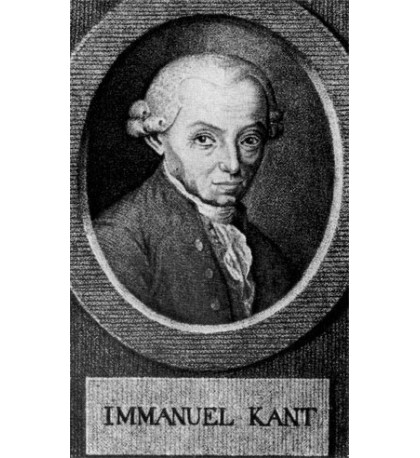
Immanuel Kant (German: Immanuel Kant) 22 April 1724, Königsberg, Prussia — 12 February 1804, there) was a German philosopher, the founder of German classical philosophy, standing on the border between the Enlightenment and Romanticism.
He was born into a poor family of a master saddler. The boy was named after Saint Emmanuel. Under the supervision of Dr. Franz Albert Schultz, a theologian who noticed Immanuel’s talents, Kant graduated from the prestigious Friedrichs-Collegium gymnasium and then entered the University of Königsberg. Because of his father’s death, he was unable to complete his studies and, in order to support his family, Kant spent 10 years as a private tutor. It was during this time, in 1747–1755, that he developed and published his cosmogonic hypothesis on the origin of the Solar System from an original nebula, which has not lost its relevance to this day. In 1755 Kant defended his dissertation and received his doctorate, which finally gave him the right to teach at the university. Forty years of teaching began. During the Seven Years’ War, from 1758 to 1762, Königsberg was under the jurisdiction of the Russian government, which was reflected in the philosopher’s business correspondence. In particular, in 1758 he addressed his petition for the post of ordinary professor to Empress Elizabeth Petrovna. Kant’s natural-scientific and philosophical investigations were supplemented by “political science” works: in the treatise Toward Perpetual Peace, he first outlined the cultural and philosophical foundations of the future unification of Europe into a family of enlightened nations, asserting that “enlightenment is man’s emergence from his self-incurred immaturity.” From 1770, the “critical” period in Kant’s work is usually dated. In this year, at the age of 46, he was appointed professor of logic and metaphysics at the University of Königsberg, where until 1797 he taught an extensive cycle of disciplines—philosophical, mathematical, and physical. By this time, Kant had arrived at a fundamentally important recognition of the aims of his work: “The long-conceived plan for how the field of pure philosophy should be worked up consisted in solving three problems:
1) What can I know
Books


Didn't find the book you were looking for?
