Isaac Babel
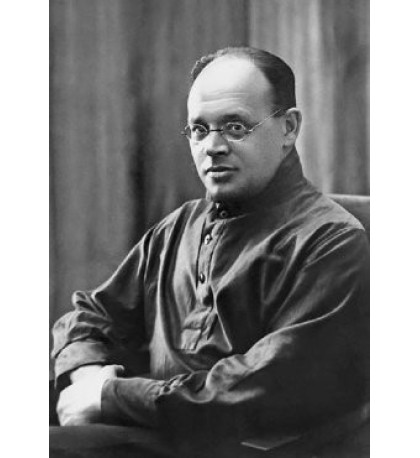
He was born in Odessa into the family of a Jewish merchant. The beginning of the century was a time of social unrest and the mass exodus of Jews from the Russian Empire. Babel himself survived the pogrom of 1905 (he was hidden by a Christian family), and his grandfather Shoil was one of the 300 Jews killed.
To enter the preparatory class of Nicholas I Odessa Commercial School, Babel had to exceed the quota for Jewish students (10% within the Pale of Settlement, 5% outside it, and 3% for both capitals), but despite the passing marks that entitled him to study, the place was given to another young man whose parents bribed the school administration. In one year of home education, Babel completed the program of two grades. In addition to the standard subjects, he studied the Talmud and took music lessons. After another unsuccessful attempt to enter Odessa University (again because of the quotas), he ended up at the Kiev Institute of Finance and Entrepreneurship. There he met his future wife, Evgenia Gronfein.
Fluent in Yiddish, Russian, and French, Babel wrote his first works in French, but they have not survived. Babel published his first stories in Russian in the magazine Letopis. Then, on M. Gorky’s advice, he “went out among the people” and changed several professions.
In 1920 he was a fighter and political worker in the Cavalry Army. In 1924 he published a number of stories that later formed the cycles Red Cavalry and Odessa Tales. Babel managed to convey masterfully in Russian the stylistics of literature created in Yiddish (this is especially noticeable in Odessa Tales, where in places the direct speech of his characters is a literal translation from Yiddish).
Soviet criticism of the time, while recognizing the talent and significance of Babel’s work, pointed to his “antipathy to the cause of the working class” and reproached him for “naturalism and an apology for the elemental and the romanticization of banditry.”
In Odessa Tales, Babel portrays in a romantic vein the life of Jewish criminals of the early 20th
Books


Didn't find the book you were looking for?
