Kavabata Yasunari
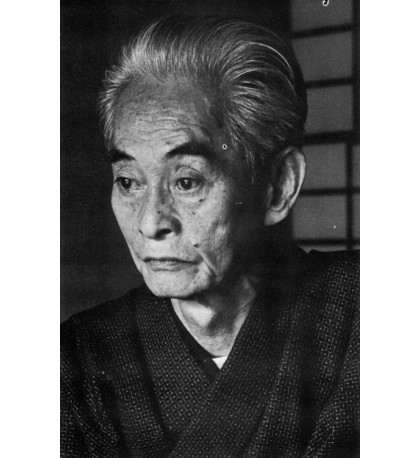
Yasunari Kawabata was an outstanding Japanese writer.
He was born in Osaka into an educated and wealthy family. His father, a physician, died when Yasunari was only two years old. After the death of his mother, which followed a year after his father’s death, the boy was taken in by his maternal grandparents. Several years later his grandmother and sister died, and the boy was left with his grandfather, whom he loved deeply. Although as a child Kawabata dreamed of becoming a painter, at the age of 12 he decided to become a writer, and in 1914, shortly before his grandfather’s death, he began writing an autobiographical story that was published in 1925 under the title “The Diary of a Sixteen-Year-Old.”
Continuing to live with relatives, Kawabata entered a high school in Tokyo and began studying European culture; he became interested in Scandinavian literature and acquainted himself with the works of such artists as Leonardo da Vinci, Michelangelo, Rembrandt, and Cézanne. In 1920 the young man entered Tokyo University in the Department of English Literature, but in his second year took up the study of Japanese literature. His article in the student magazine Shinsei attracted the attention of the writer Kan Kikuchi, who suggested that Kawabata, who at that time (1923) was in his final year, become a member of the editorial staff of the literary magazine Bungei Shunjū. In these years Kawabata, together with a group of young writers, founded the magazine Bungei Jidai, the mouthpiece of the modernist trend in Japanese literature known as the “neo-sensualists.”
The first literary success of the aspiring writer was the novella “The Izu Dancer” (1925), which tells of a student who falls in love with a young dancer. The two central characters, the autobiographical hero and the innocent girl-heroine, run through all of Kawabata’s work. Yukio Mishima spoke of the “cult of the virgin” characteristic of Kawabata’s work as “the source of his pure lyricism, which at the same time creates a gloomy, hopeless mood”:
For the loss of virginity may be likened to the loss of
Books
Didn't find the book you were looking for?
